📖 View in Flipbook All editions
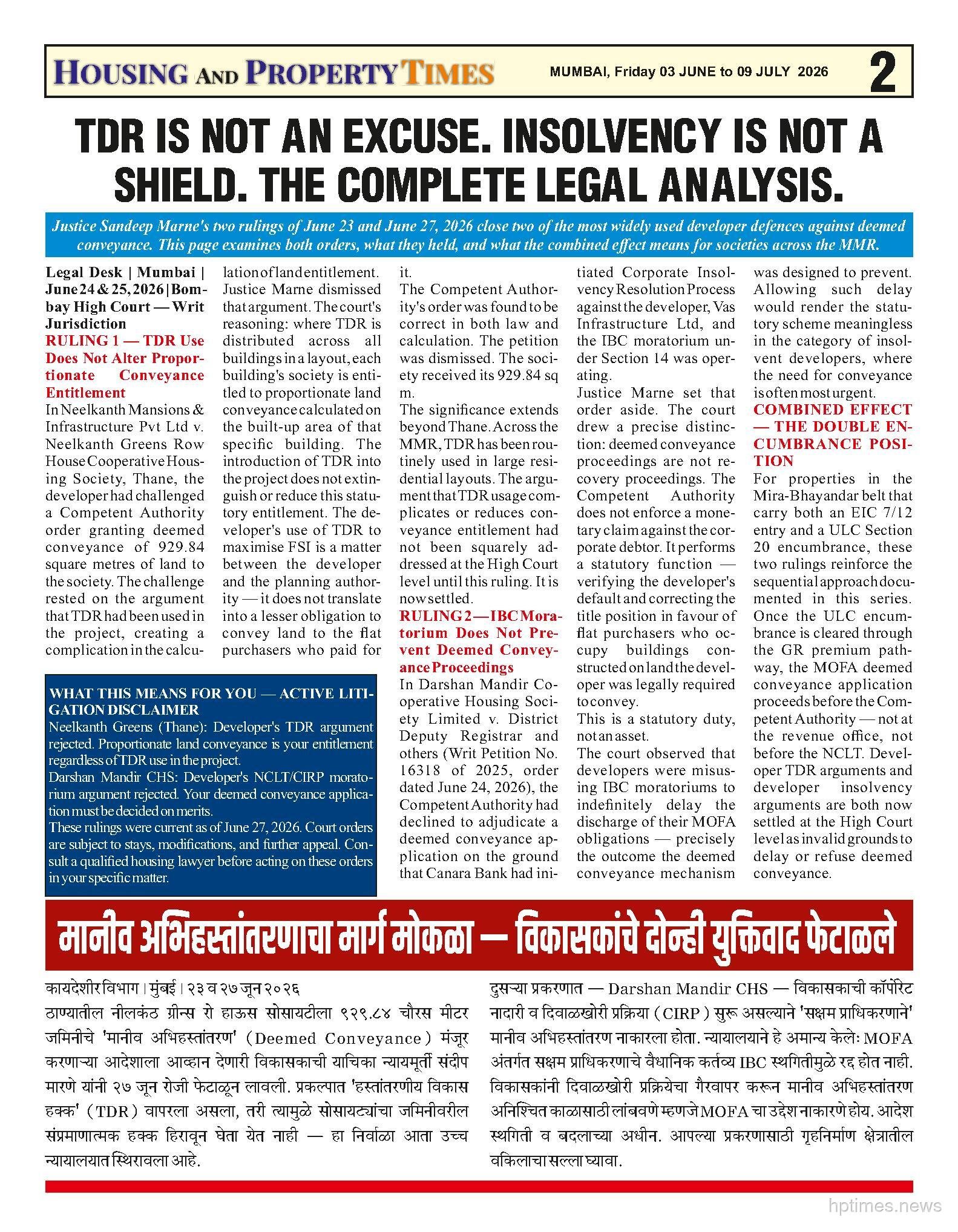
TDR IS NOT AN EXCUSE. INSOLVENCY IS NOT A SHIELD. THE COMPLETE LEGAL ANALYSIS.
RULING 1 — TDR Use Does Not Alter Proportionate Conveyance Entitlement In Neelkanth Mansions & Infrastructure Pvt Ltd v. Neelkanth Greens Row House Cooperative Housing Society, Thane, the developer challenged a Competent Authority order granting deemed conveyance of 929.84 square metres of land to the society. The challenge rested on the argument that TDR had been used in the project, creating a complication in the calculation of land entitlement. Justice Marne dismissed that argument. The court's reasoning: where TDR is distributed across all buildings in a layout, each building's society is entitled to proportionate land conveyance calculated on the built-up area of that specific building. The introduction of TDR into the project does not extinguish or reduce this statutory entitlement. The developer's use of TDR to maximise FSI is a matter between the developer and the planning authority — it does not translate into a lesser obligation to convey land to the flat purchasers who paid for it. The Competent Authority's order was found to be correct in both law and calculation. The petition was dismissed. The society received its 929.84 sq m. The significance extends beyond Thane. Across the MMR, TDR has been routinely used in large residential layouts. The argument that TDR usage complicates or reduces conveyance entitlement had not been squarely addressed at the High Court level until this ruling. It is now settled. RULING 2 — IBC Moratorium Does Not Prevent Deemed Conveyance Proceedings In Darshan Mandir Co-operative Housing Society Limited v. District Deputy Registrar and others (Writ Petition No. 16318 of 2025, order dated June 24, 2026), the Competent Authority had declined to adjudicate a deemed conveyance application on the ground that Canara Bank had initiated Corporate Insolvency Resolution Process against the developer, Vas Infrastructure Ltd, and the IBC moratorium under Section 14 was operating. Justice Marne set that order aside. The court drew a precise distinction: deemed conveyance proceedings are not recovery proceedings. The Competent Authority does not enforce a monetary claim against the corporate debtor. It performs a statutory function — verifying the developer's default and correcting the title position in favour of flat purchasers who occupy buildings constructed on land the developer was legally required to convey. This is a statutory duty, not an asset. The court observed that developers were misusing IBC moratoriums to indefinitely delay the discharge of their MOFA obligations — precisely the outcome the deemed conveyance mechanism was designed to prevent. Allowing such delay would render the statutory scheme meaningless in the category of insolvent developers, where the need for conveyance is often most urgent. COMBINED EFFECT — THE DOUBLE ENCUMBRANCE POSITION For properties in the Mira-Bhayandar belt that carry both an EIC 7/12 entry and a ULC Section 20 encumbrance, these two rulings reinforce the sequential approach documented in this series. Once the ULC encumbrance is cleared through the GR premium pathway, the MOFA deemed conveyance application proceeds before the Competent Authority — not at the revenue office, not before the NCLT. Developer TDR arguments and developer insolvency arguments are both now settled at the High Court level as invalid grounds to delay or refuse deemed conveyance. ACTIVE LITIGATION DISCLAIMER: Neelkanth Greens (Thane): Developer's TDR argument rejected. Proportionate land conveyance is your entitlement regardless of TDR use in the project. Darshan Mandir CHS: Developer's NCLT/CIRP moratorium argument rejected. Your deemed conveyance application must be decided on merits. These rulings were current as of June 27, 2026. Court orders are subject to stays, modifications, and further appeal. Consult a qualified housing lawyer before acting on these orders in your specific matter.
React
More from this issue & web
 Page 1
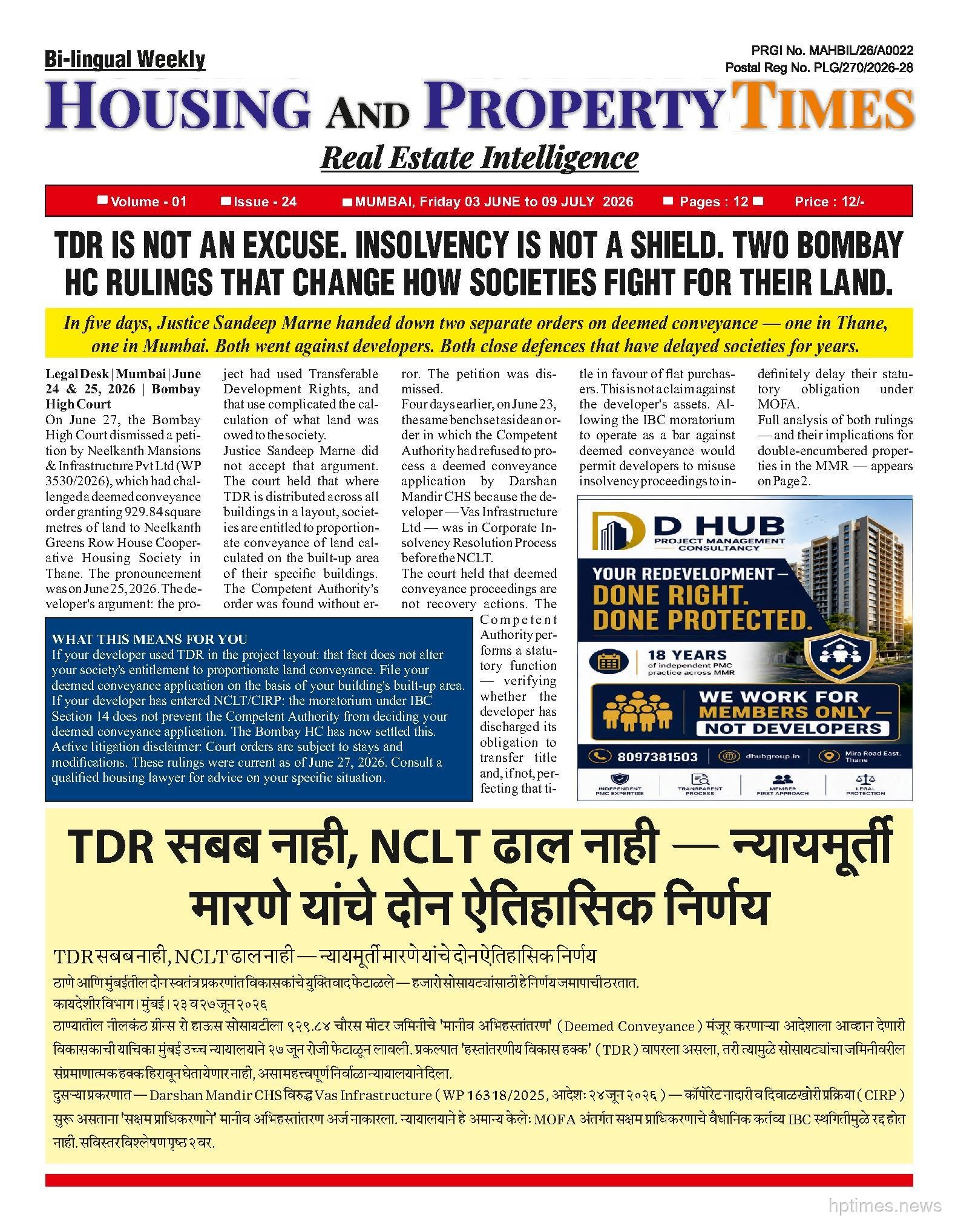
TDR IS NOT AN EXCUSE. INSOLVENCY IS NOT A SHIELD. TWO BOMBAY HC RULINGS THAT CHANGE HOW SOCIETIES FIGHT FOR THEIR LAND.
Page 1
TDR IS NOT AN EXCUSE. INSOLVENCY IS NOT A SHIELD. TWO BOMBAY HC RULINGS THAT CHANGE HOW SOCIETIES FIGHT FOR THEIR LAND.
 Page 3
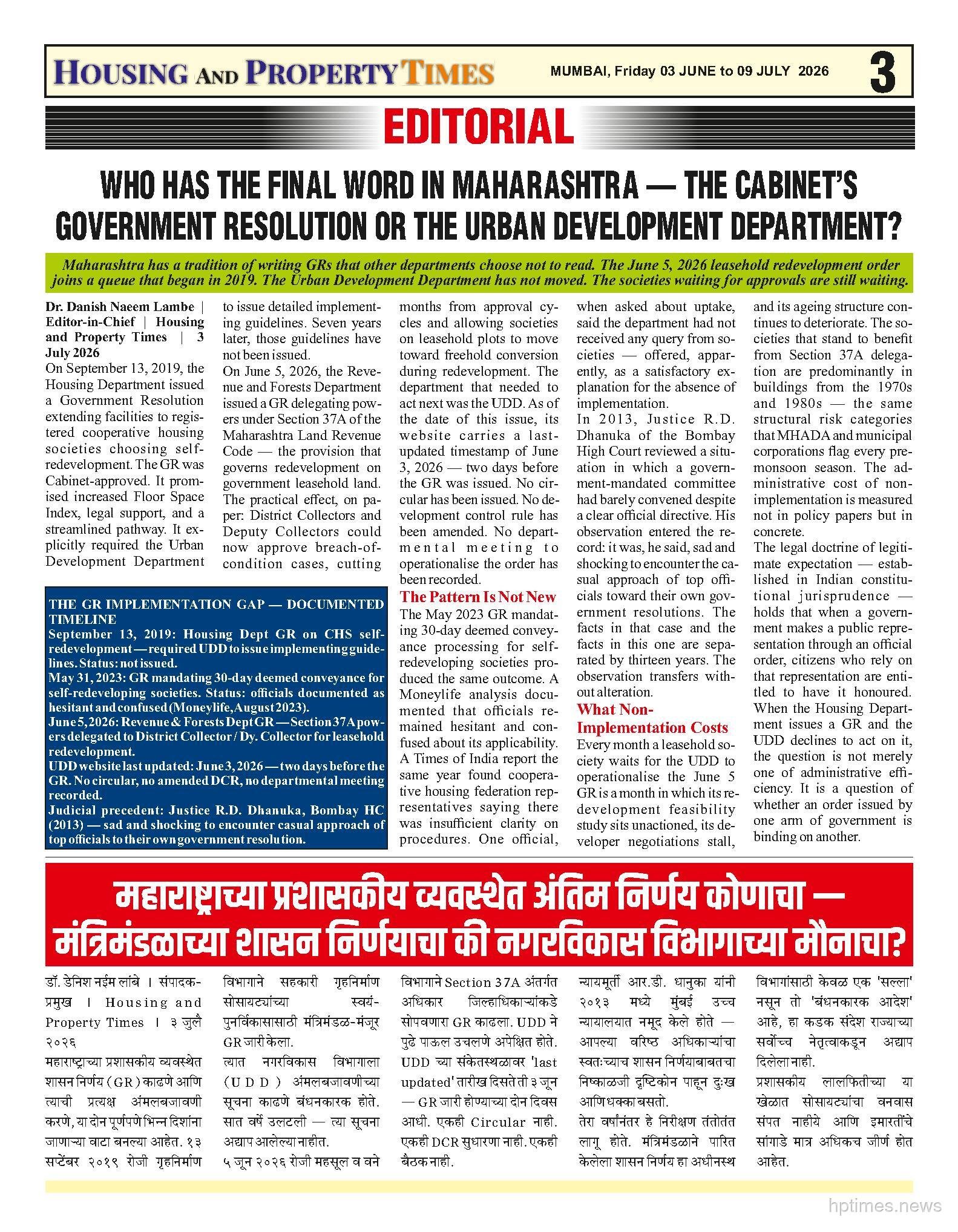
THE STATE MOVES. THE SUPREME COURT IS NOW THE BATTLEFIELD FOR 254.88 ACRES OF MIRA-BHAYANDAR.
Page 3
THE STATE MOVES. THE SUPREME COURT IS NOW THE BATTLEFIELD FOR 254.88 ACRES OF MIRA-BHAYANDAR.
 Page 4
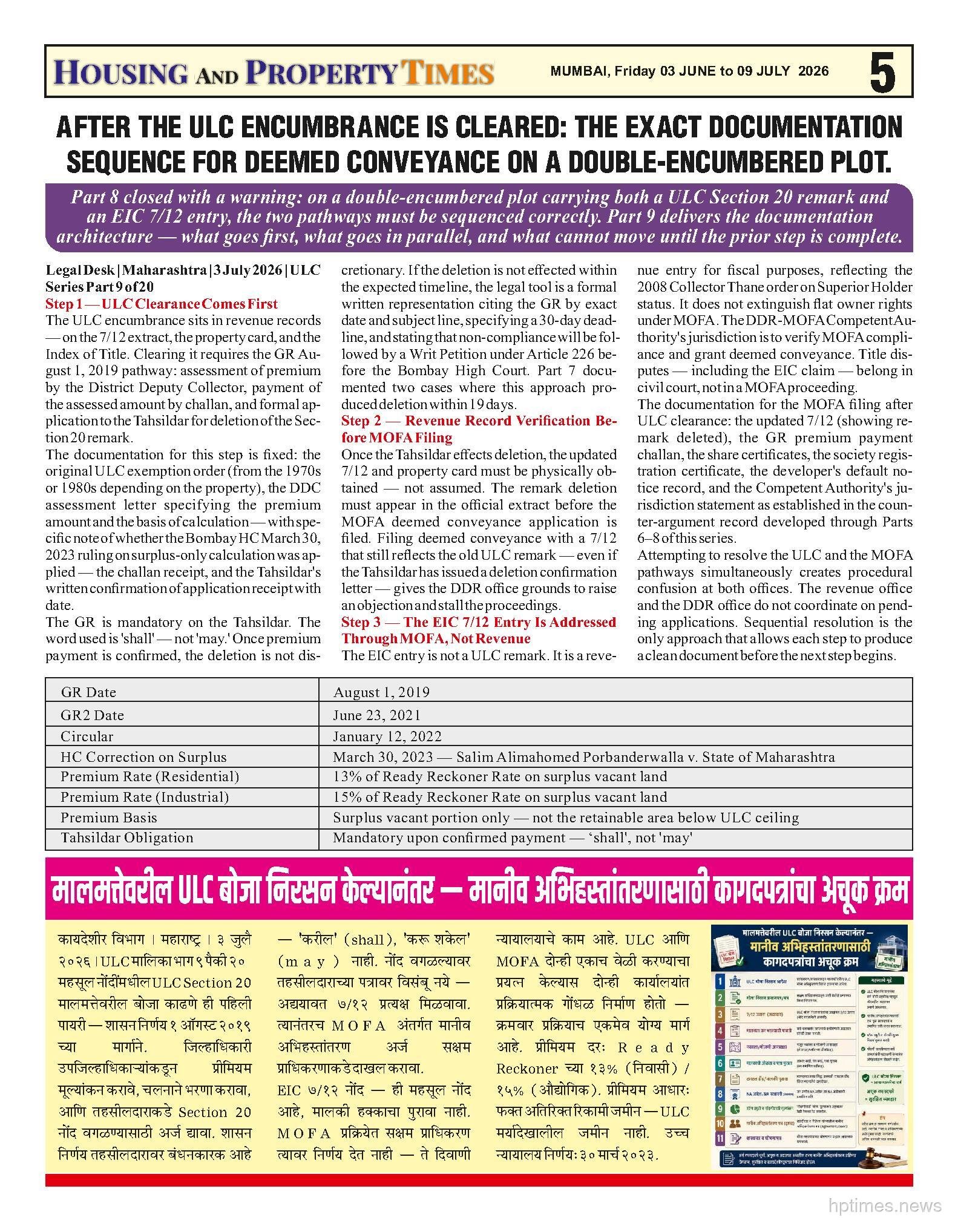
AFTER THE ULC ENCUMBRANCE IS CLEARED: THE EXACT DOCUMENTATION SEQUENCE FOR DEEMED CONVEYANCE ON A DOUBLE-ENCUMBERED PLOT.
Page 4
AFTER THE ULC ENCUMBRANCE IS CLEARED: THE EXACT DOCUMENTATION SEQUENCE FOR DEEMED CONVEYANCE ON A DOUBLE-ENCUMBERED PLOT.
 Page 5
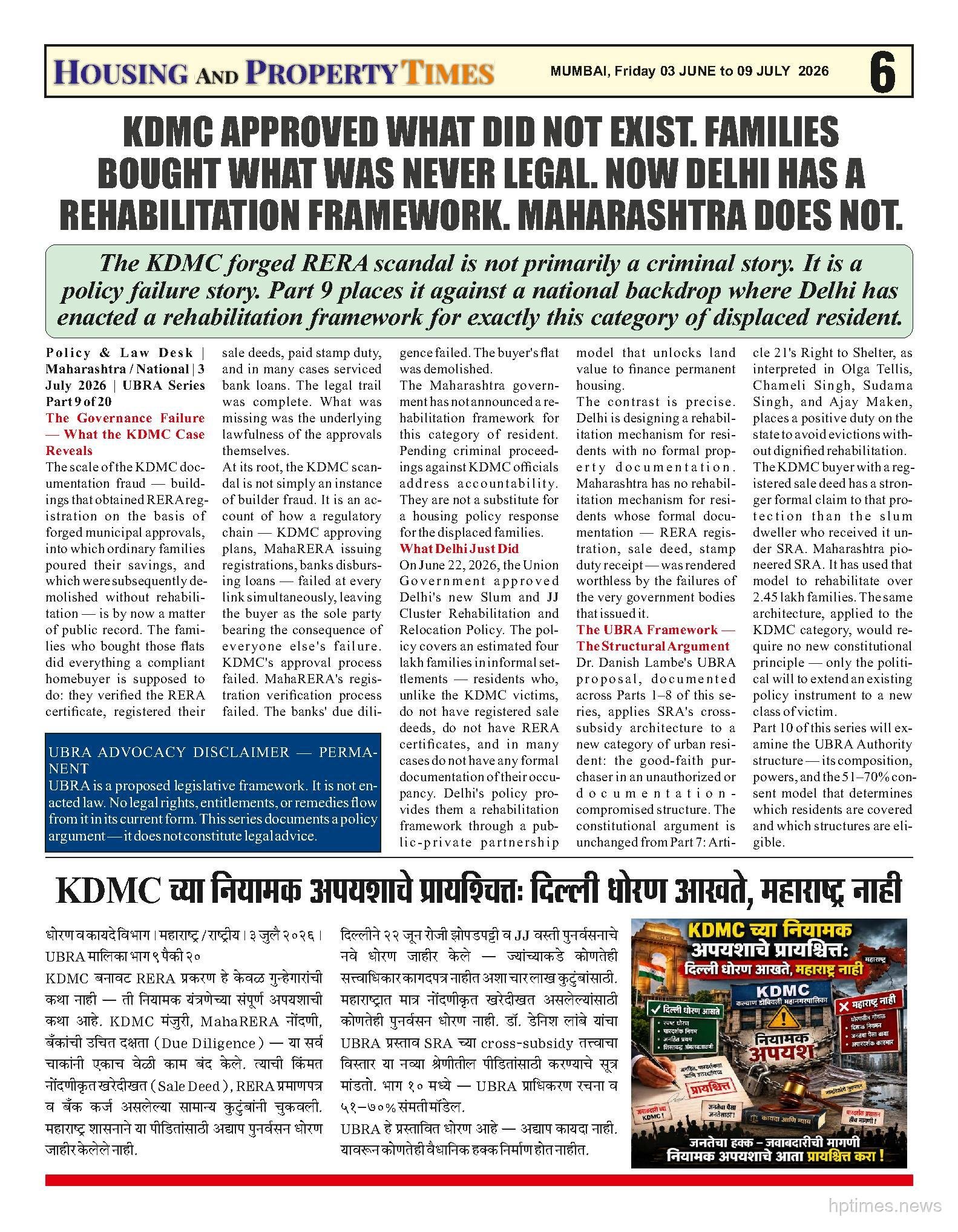
KDMC APPROVED WHAT DID NOT EXIST. FAMILIES BOUGHT WHAT WAS NEVER LEGAL. NOW DELHI HAS A REHABILITATION FRAMEWORK. MAHARASHTRA DOES NOT.
Page 5
KDMC APPROVED WHAT DID NOT EXIST. FAMILIES BOUGHT WHAT WAS NEVER LEGAL. NOW DELHI HAS A REHABILITATION FRAMEWORK. MAHARASHTRA DOES NOT.
 Page 6
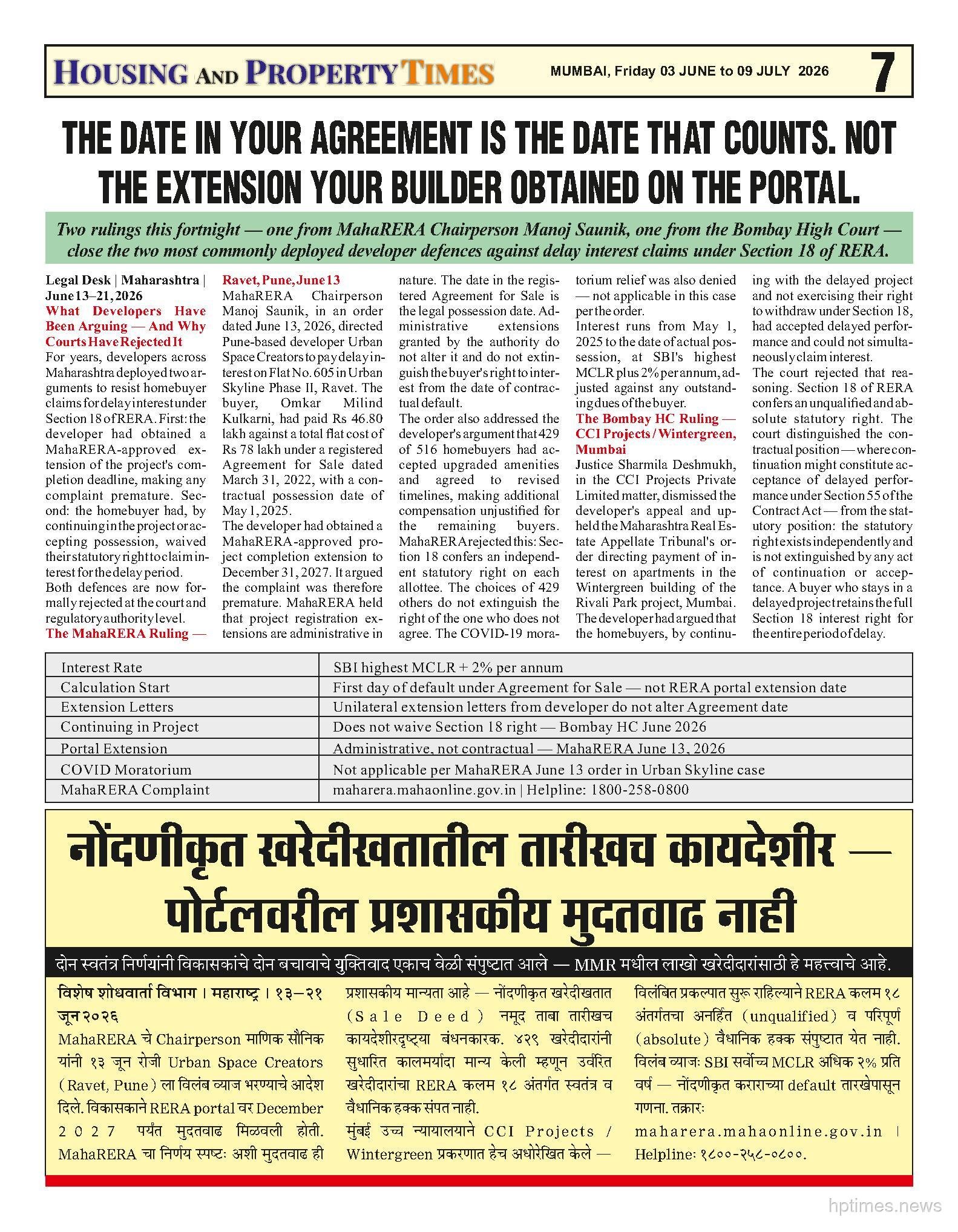
THE DATE IN YOUR AGREEMENT IS THE DATE THAT COUNTS. NOT THE EXTENSION YOUR BUILDER OBTAINED ON THE PORTAL.
Page 6
THE DATE IN YOUR AGREEMENT IS THE DATE THAT COUNTS. NOT THE EXTENSION YOUR BUILDER OBTAINED ON THE PORTAL.
 Page 7
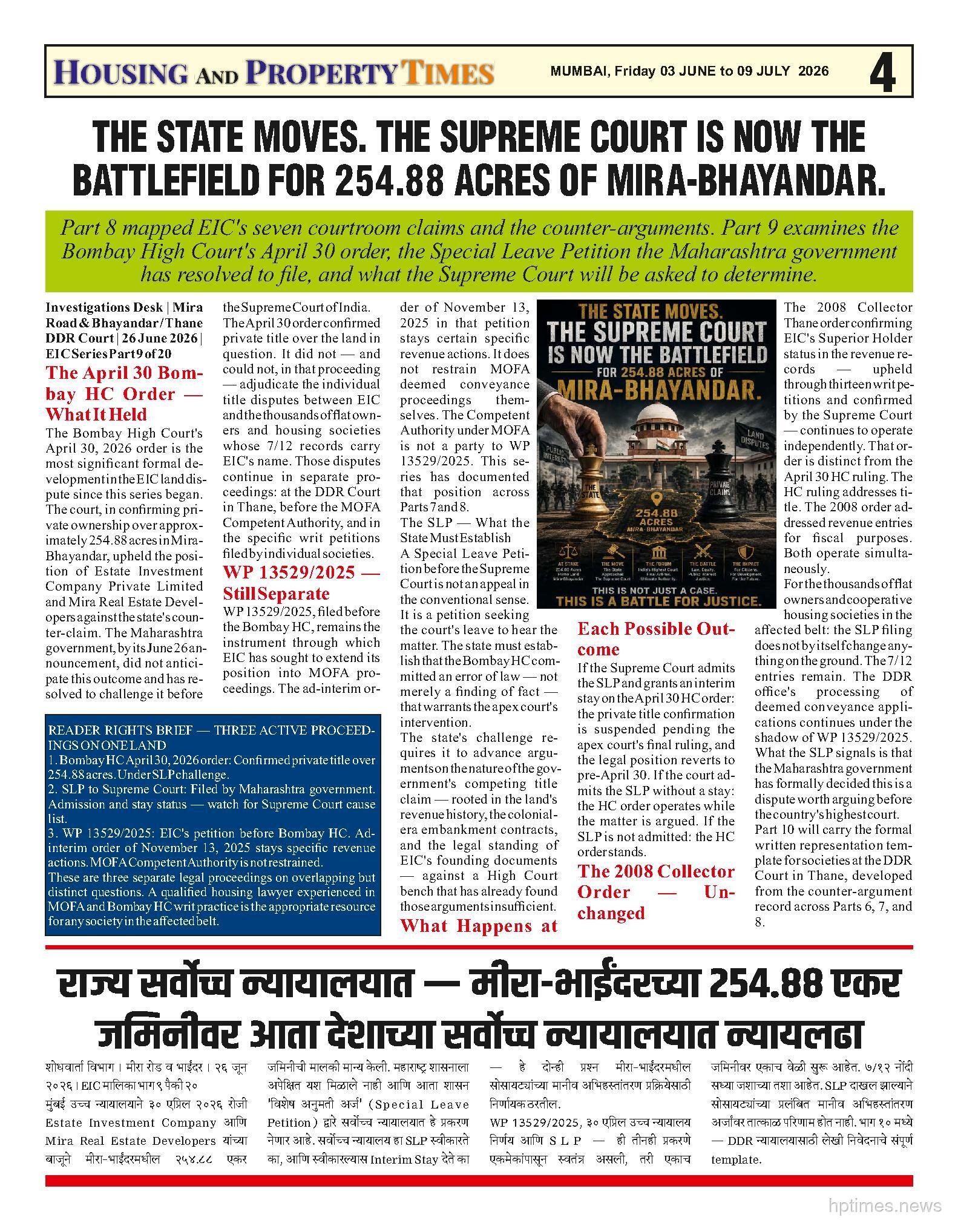
WHO HAS THE FINAL WORD IN MAHARASHTRA — THE CABINET'S GOVERNMENT RESOLUTION OR THE URBAN DEVELOPMENT DEPARTMENT?
Page 7
WHO HAS THE FINAL WORD IN MAHARASHTRA — THE CABINET'S GOVERNMENT RESOLUTION OR THE URBAN DEVELOPMENT DEPARTMENT?
Comments (0)