📖 View in Flipbook All editions
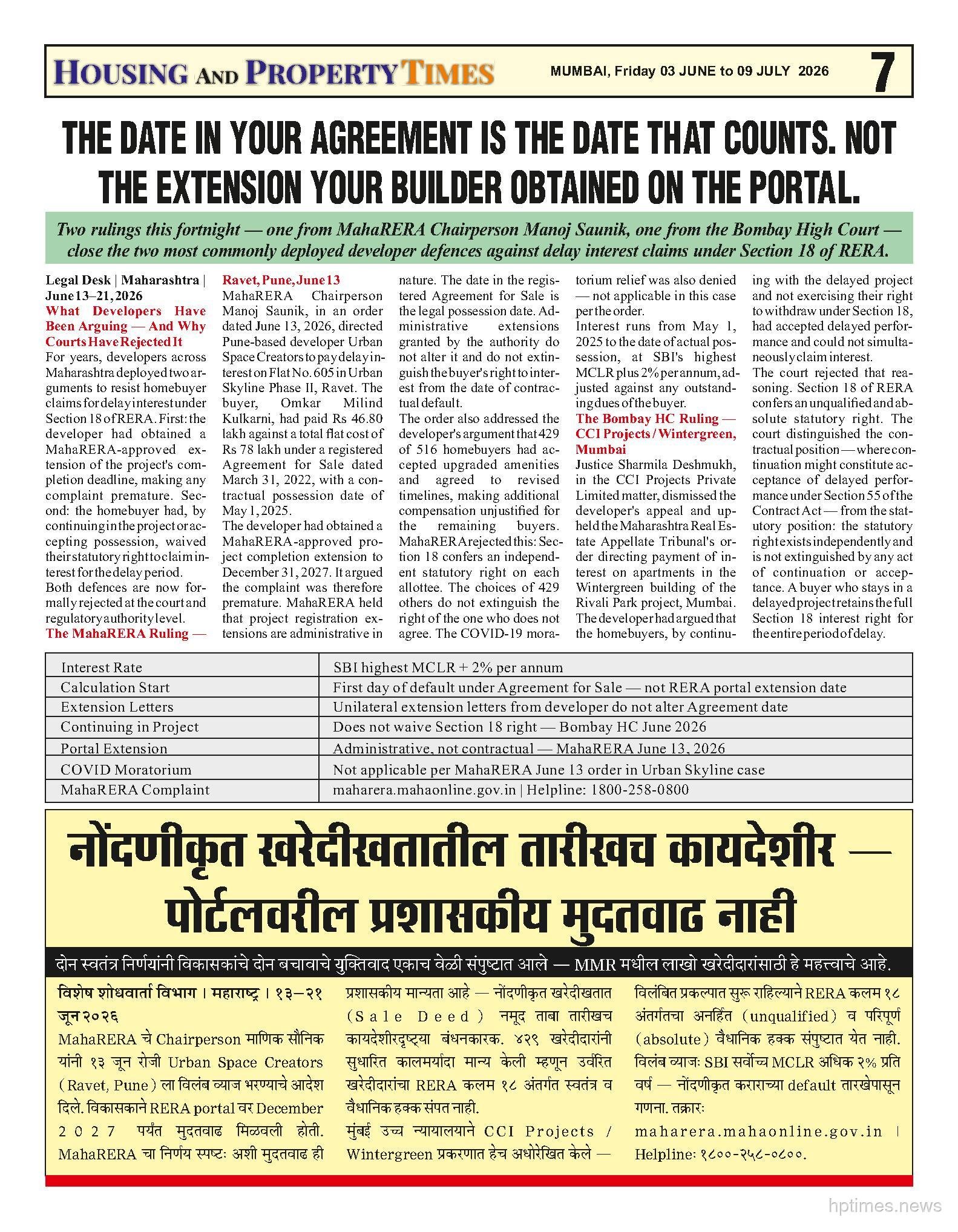
WHO HAS THE FINAL WORD IN MAHARASHTRA — THE CABINET'S GOVERNMENT RESOLUTION OR THE URBAN DEVELOPMENT DEPARTMENT?
On September 13, 2019, the Housing Department issued a Government Resolution extending facilities to registered cooperative housing societies choosing self-redevelopment. The GR was Cabinet-approved. It promised increased Floor Space Index, legal support, and a streamlined pathway. It explicitly required the Urban Development Department to issue detailed implementing guidelines. Seven years later, those guidelines have not been issued. On June 5, 2026, the Revenue and Forests Department issued a GR delegating powers under Section 37A of the Maharashtra Land Revenue Code — the provision that governs redevelopment on government leasehold land. The practical effect, on paper: District Collectors and Deputy Collectors could now approve breach-of-condition cases, cutting months from approval cycles and allowing societies on leasehold plots to move toward freehold conversion during redevelopment. The department that needed to act next was the UDD. As of the date of this issue, its website carries a last-updated timestamp of June 3, 2026 — two days before the GR was issued. No circular has been issued. No development control rule has been amended. No departmental meeting to operationalise the order has been recorded. The Pattern Is Not New The May 2023 GR mandating 30-day deemed conveyance processing for self-redeveloping societies produced the same outcome. A Moneylife analysis documented that officials remained hesitant and confused about its applicability. A Times of India report the same year found cooperative housing federation representatives saying there was insufficient clarity on procedures. One official, when asked about uptake, said the department had not received any query from societies — offered, apparently, as a satisfactory explanation for the absence of implementation. In 2013, Justice R.D. Dhanuka of the Bombay High Court reviewed a situation in which a government-mandated committee had barely convened despite a clear official directive. His observation entered the record: it was, he said, sad and shocking to encounter the casual approach of top officials toward their own government resolutions. The facts in that case and the facts in this one are separated by thirteen years. The observation transfers without alteration. What Non-Implementation Costs Every month a leasehold society waits for the UDD to operationalise the June 5 GR is a month in which its redevelopment feasibility study sits unactioned, its developer negotiations stall, and its ageing structure continues to deteriorate. The societies that stand to benefit from Section 37A delegation are predominantly in buildings from the 1970s and 1980s — the same structural risk categories that MHADA and municipal corporations flag every pre-monsoon season. The administrative cost of non-implementation is measured not in policy papers but in concrete. The legal doctrine of legitimate expectation — established in Indian constitutional jurisprudence — holds that when a government makes a public representation through an official order, citizens who rely on that representation are entitled to have it honoured. When the Housing Department issues a GR and the UDD declines to act on it, the question is not merely one of administrative efficiency. It is a question of whether an order issued by one arm of government is binding on another. The Structural Problem Maharashtra does not lack GRs. It lacks a mechanism that prevents one department from outlasting a directive issued by another. The Housing Department, the Revenue Department, and the Urban Development Department operate as distinct power centres with distinct political patrons, budget lines, and institutional interests. A resolution issued by one is not automatically adopted by another. The gap between issuance and implementation is where projects die, where societies age into the dangerous building lists, and where the credibility of governance reform is quietly eroded. The societies affected by this gap have legal standing. Article 14 equal protection and Article 300A property rights provide the constitutional basis for a writ petition or PIL compelling the UDD to explain its non-action. Courts have compelled this department before. What the legal avenue cannot supply — and what the courts cannot substitute for — is the political signal from the state's top leadership that a GR issued by the Cabinet is not a suggestion that subordinate departments may choose to ignore. That signal has not come. The queue of unimplemented housing resolutions grows longer. The buildings age. The societies wait. THE GR IMPLEMENTATION GAP — DOCUMENTED TIMELINE: September 13, 2019: Housing Dept GR on CHS self-redevelopment — required UDD to issue implementing guidelines. Status: not issued. May 31, 2023: GR mandating 30-day deemed conveyance for self-redeveloping societies. Status: officials documented as hesitant and confused (Moneylife, August 2023). June 5, 2026: Revenue & Forests Dept GR — Section 37A powers delegated to District Collector / Dy. Collector for leasehold redevelopment. UDD website last updated: June 3, 2026 — two days before the GR. No circular, no amended DCR, no departmental meeting recorded. Judicial precedent: Justice R.D. Dhanuka, Bombay HC (2013) — sad and shocking to encounter casual approach of top officials to their own government resolution.
React
More from this issue & web
 Page 1
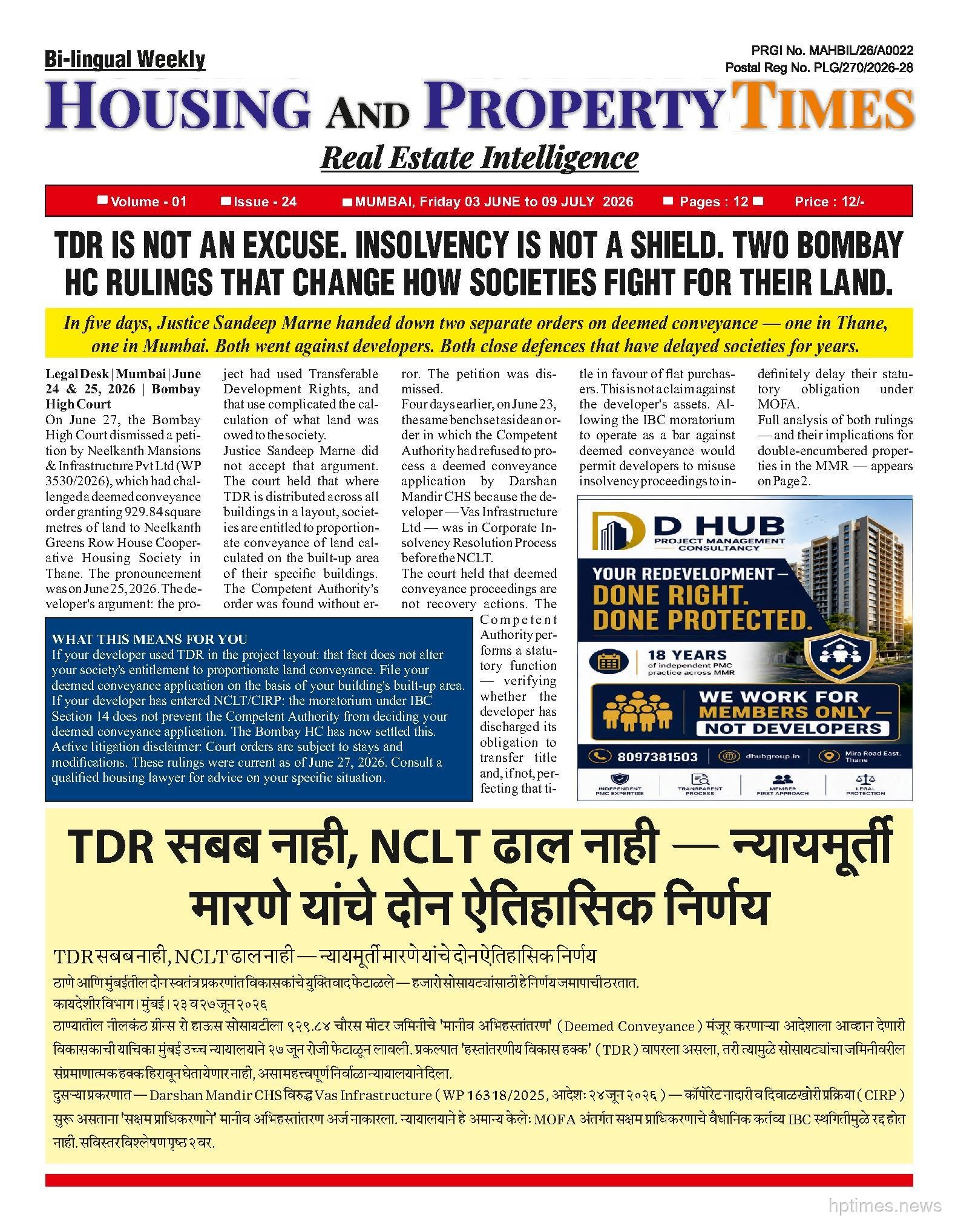
TDR IS NOT AN EXCUSE. INSOLVENCY IS NOT A SHIELD. TWO BOMBAY HC RULINGS THAT CHANGE HOW SOCIETIES FIGHT FOR THEIR LAND.
Page 1
TDR IS NOT AN EXCUSE. INSOLVENCY IS NOT A SHIELD. TWO BOMBAY HC RULINGS THAT CHANGE HOW SOCIETIES FIGHT FOR THEIR LAND.
 Page 2
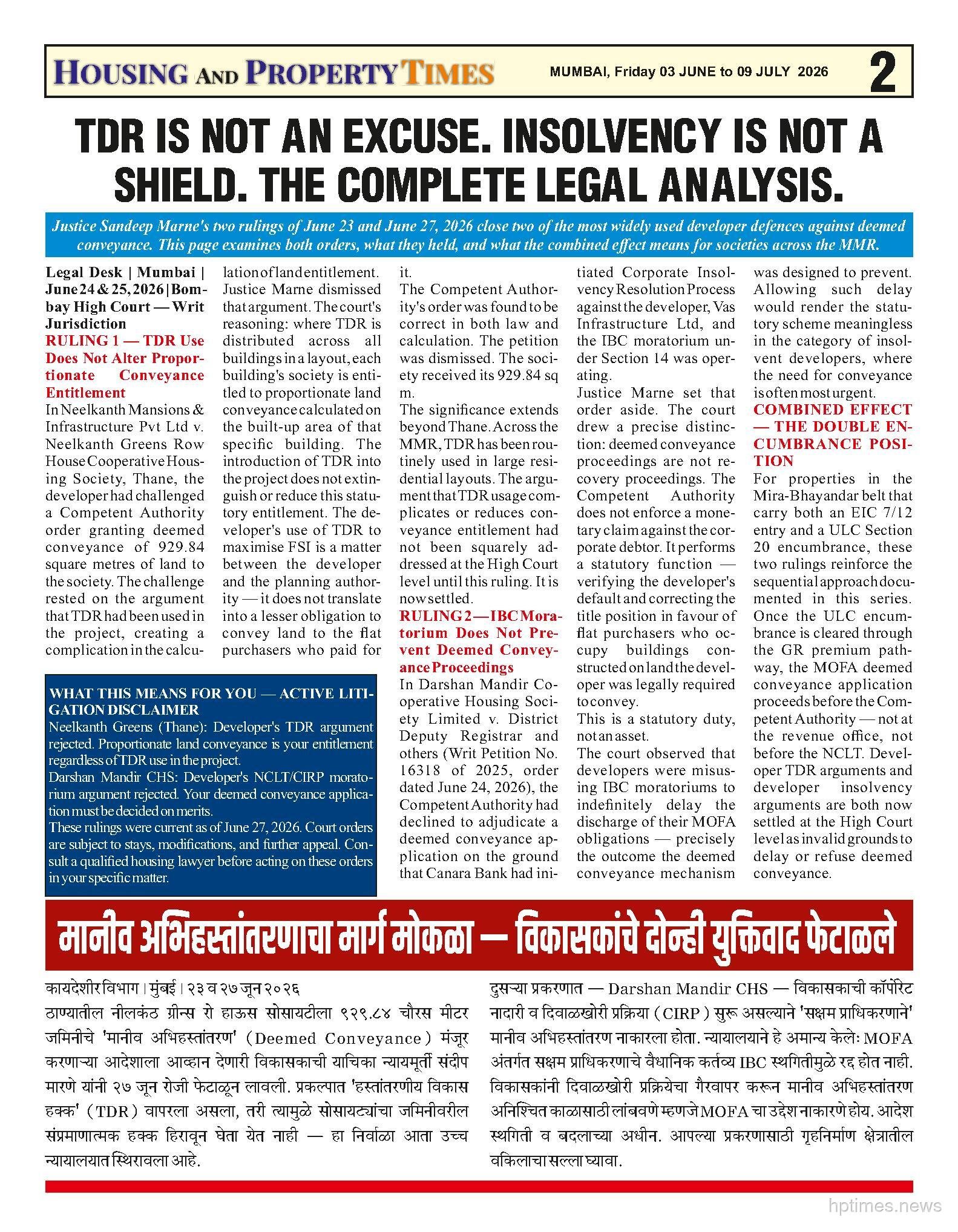
TDR IS NOT AN EXCUSE. INSOLVENCY IS NOT A SHIELD. THE COMPLETE LEGAL ANALYSIS.
Page 2
TDR IS NOT AN EXCUSE. INSOLVENCY IS NOT A SHIELD. THE COMPLETE LEGAL ANALYSIS.
 Page 3
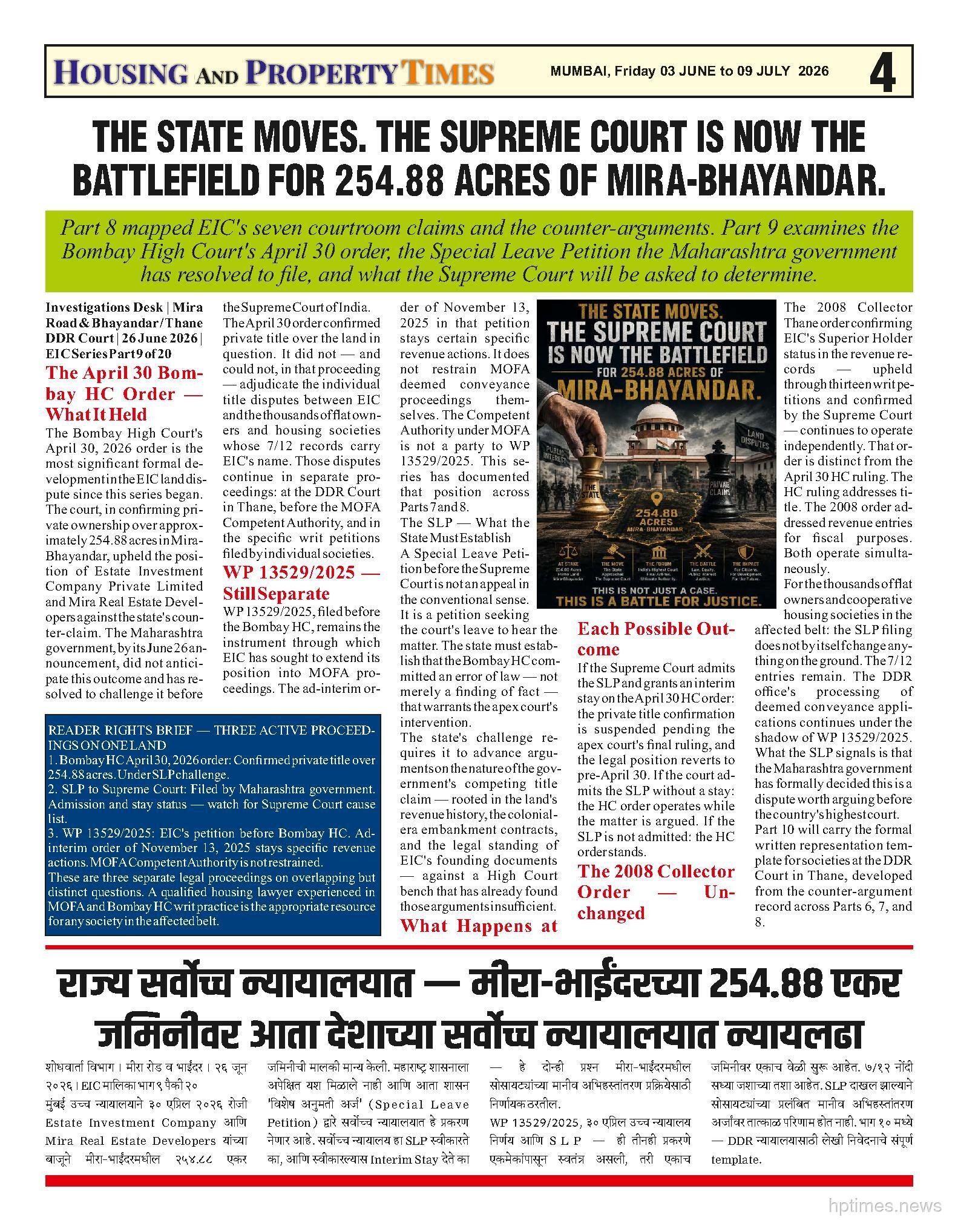
THE STATE MOVES. THE SUPREME COURT IS NOW THE BATTLEFIELD FOR 254.88 ACRES OF MIRA-BHAYANDAR.
Page 3
THE STATE MOVES. THE SUPREME COURT IS NOW THE BATTLEFIELD FOR 254.88 ACRES OF MIRA-BHAYANDAR.
 Page 4
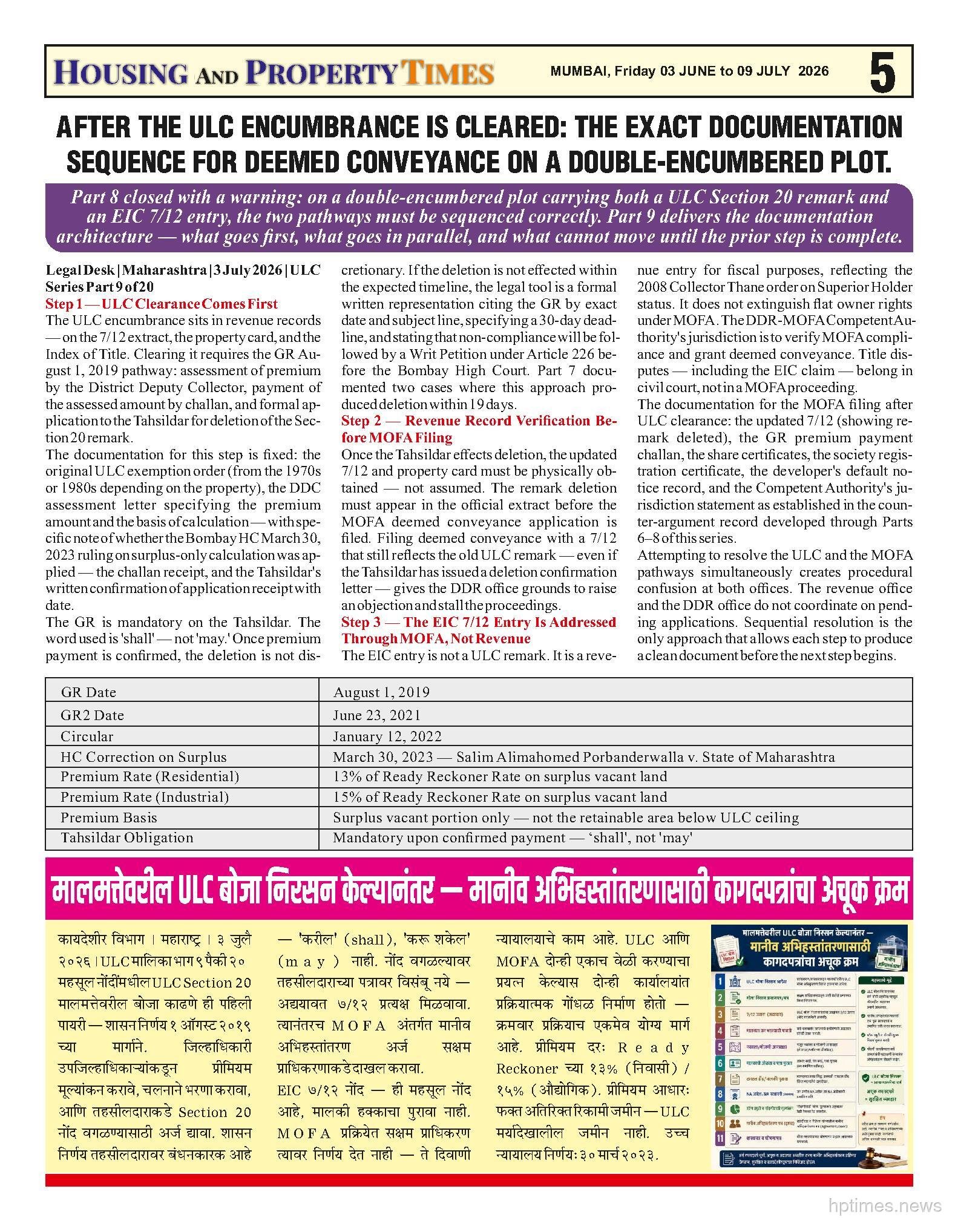
AFTER THE ULC ENCUMBRANCE IS CLEARED: THE EXACT DOCUMENTATION SEQUENCE FOR DEEMED CONVEYANCE ON A DOUBLE-ENCUMBERED PLOT.
Page 4
AFTER THE ULC ENCUMBRANCE IS CLEARED: THE EXACT DOCUMENTATION SEQUENCE FOR DEEMED CONVEYANCE ON A DOUBLE-ENCUMBERED PLOT.
 Page 5
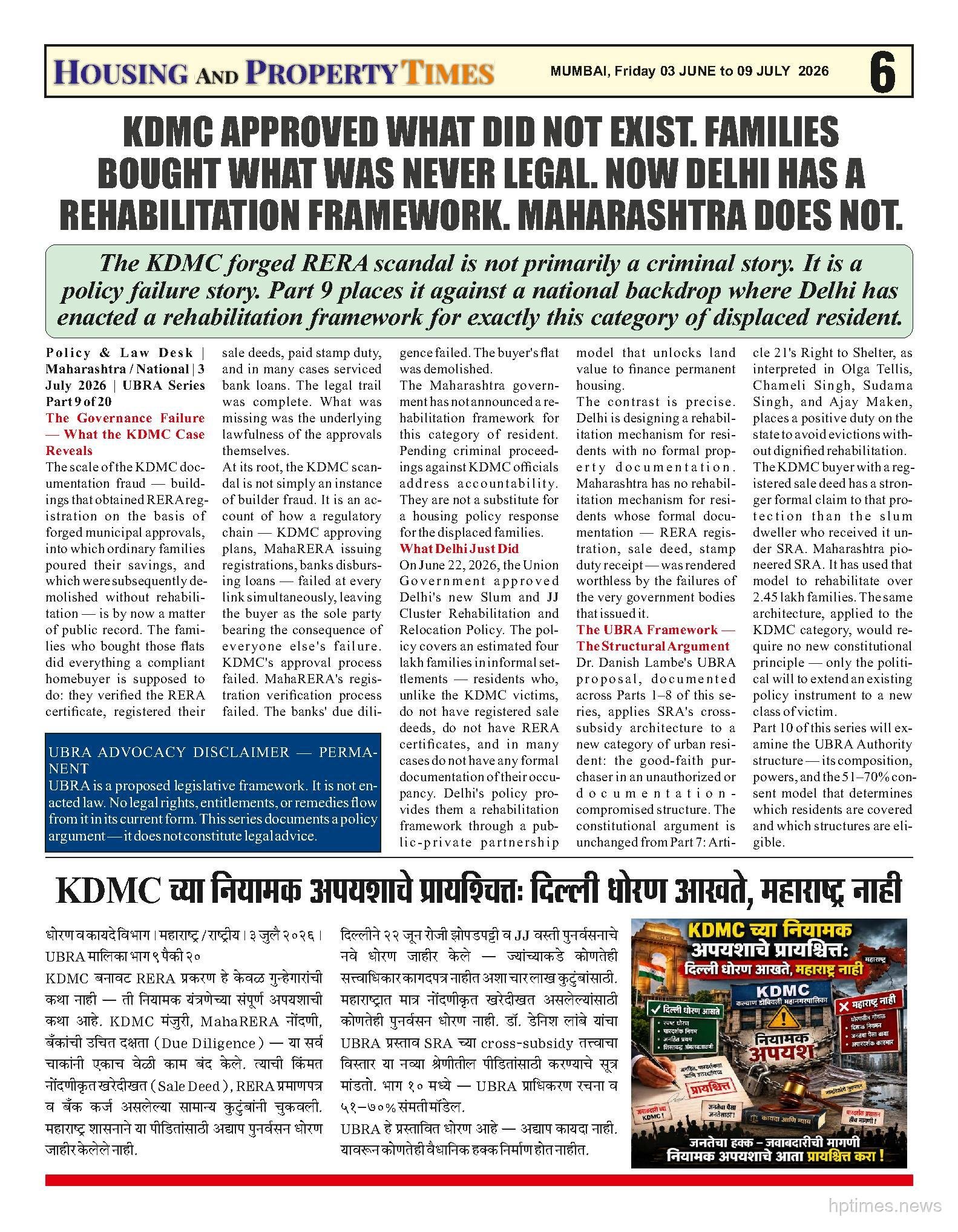
KDMC APPROVED WHAT DID NOT EXIST. FAMILIES BOUGHT WHAT WAS NEVER LEGAL. NOW DELHI HAS A REHABILITATION FRAMEWORK. MAHARASHTRA DOES NOT.
Page 5
KDMC APPROVED WHAT DID NOT EXIST. FAMILIES BOUGHT WHAT WAS NEVER LEGAL. NOW DELHI HAS A REHABILITATION FRAMEWORK. MAHARASHTRA DOES NOT.
 Page 6
THE DATE IN YOUR AGREEMENT IS THE DATE THAT COUNTS. NOT THE EXTENSION YOUR BUILDER OBTAINED ON THE PORTAL.
Page 6
THE DATE IN YOUR AGREEMENT IS THE DATE THAT COUNTS. NOT THE EXTENSION YOUR BUILDER OBTAINED ON THE PORTAL.
Comments (0)