📖 View in Flipbook All editions
KDMC APPROVED WHAT DID NOT EXIST. FAMILIES BOUGHT WHAT WAS NEVER LEGAL. NOW DELHI HAS A REHABILITATION FRAMEWORK. MAHARASHTRA DOES NOT.
The Governance Failure — What the KDMC Case Reveals The scale of the KDMC documentation fraud — buildings that obtained RERA registration on the basis of forged municipal approvals, into which ordinary families poured their savings, and which were subsequently demolished without rehabilitation — is by now a matter of public record. The families who bought those flats did everything a compliant homebuyer is supposed to do: they verified the RERA certificate, registered their sale deeds, paid stamp duty, and in many cases serviced bank loans. The legal trail was complete. What was missing was the underlying lawfulness of the approvals themselves. At its root, the KDMC scandal is not simply an instance of builder fraud. It is an account of how a regulatory chain — KDMC approving plans, MahaRERA issuing registrations, banks disbursing loans — failed at every link simultaneously, leaving the buyer as the sole party bearing the consequence of everyone else's failure. KDMC's approval process failed. MahaRERA's registration verification process failed. The banks' due diligence failed. The buyer's flat was demolished. The Maharashtra government has not announced a rehabilitation framework for this category of resident. Pending criminal proceedings against KDMC officials address accountability. They are not a substitute for a housing policy response for the displaced families. What Delhi Just Did On June 22, 2026, the Union Government approved Delhi's new Slum and JJ Cluster Rehabilitation and Relocation Policy. The policy covers an estimated four lakh families in informal settlements — residents who, unlike the KDMC victims, do not have registered sale deeds, do not have RERA certificates, and in many cases do not have any formal documentation of their occupancy. Delhi's policy provides them a rehabilitation framework through a public-private partnership model that unlocks land value to finance permanent housing. The contrast is precise. Delhi is designing a rehabilitation mechanism for residents with no formal property documentation. Maharashtra has no rehabilitation mechanism for residents whose formal documentation — RERA registration, sale deed, stamp duty receipt — was rendered worthless by the failures of the very government bodies that issued it. The UBRA Framework — The Structural Argument Dr. Danish Lambe's UBRA proposal, documented across Parts 1–8 of this series, applies SRA's cross-subsidy architecture to a new category of urban resident: the good-faith purchaser in an unauthorized or documentation-compromised structure. The constitutional argument is unchanged from Part 7: Article 21's Right to Shelter, as interpreted in Olga Tellis, Chameli Singh, Sudama Singh, and Ajay Maken, places a positive duty on the state to avoid evictions without dignified rehabilitation. The KDMC buyer with a registered sale deed has a stronger formal claim to that protection than the slum dweller who received it under SRA. Maharashtra pioneered SRA. It has used that model to rehabilitate over 2.45 lakh families. The same architecture, applied to the KDMC category, would require no new constitutional principle — only the political will to extend an existing policy instrument to a new class of victim. Part 10 of this series will examine the UBRA Authority structure — its composition, powers, and the 51–70% consent model that determines which residents are covered and which structures are eligible. UBRA ADVOCACY DISCLAIMER — PERMANENT: UBRA is a proposed legislative framework. It is not enacted law. No legal rights, entitlements, or remedies flow from it in its current form. This series documents a policy argument — it does not constitute legal advice.
React
More from this issue & web
 Page 1
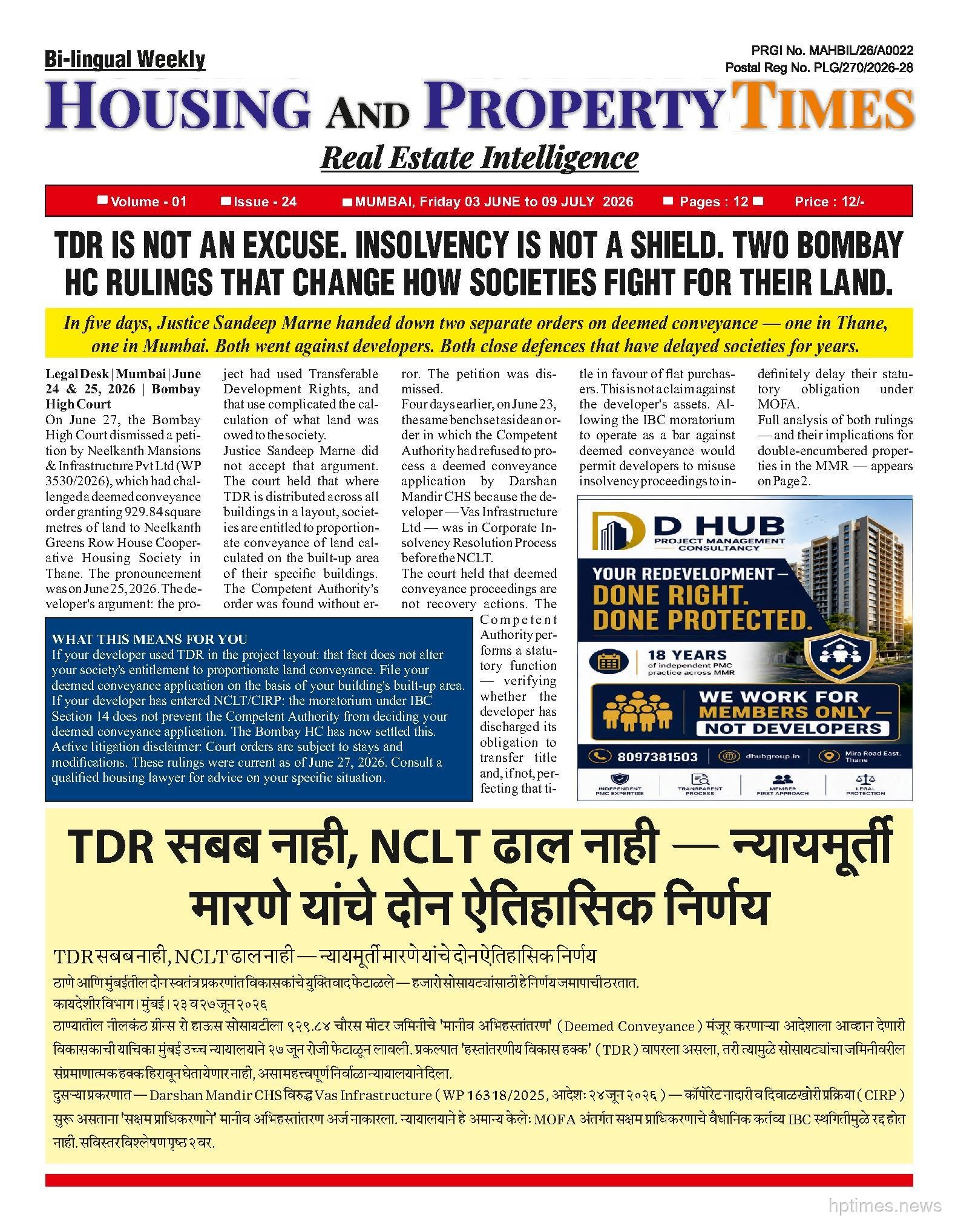
TDR IS NOT AN EXCUSE. INSOLVENCY IS NOT A SHIELD. TWO BOMBAY HC RULINGS THAT CHANGE HOW SOCIETIES FIGHT FOR THEIR LAND.
Page 1
TDR IS NOT AN EXCUSE. INSOLVENCY IS NOT A SHIELD. TWO BOMBAY HC RULINGS THAT CHANGE HOW SOCIETIES FIGHT FOR THEIR LAND.
 Page 2
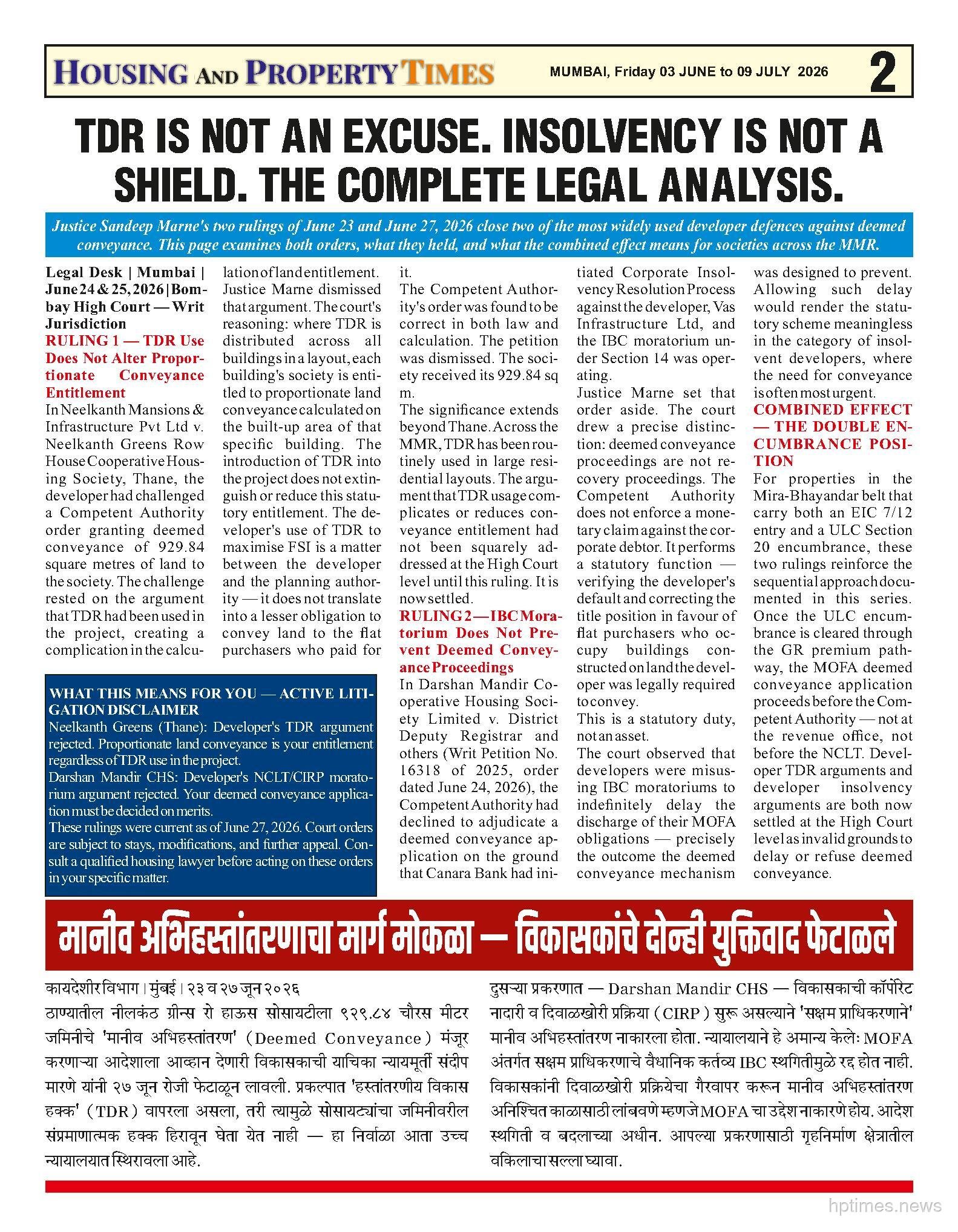
TDR IS NOT AN EXCUSE. INSOLVENCY IS NOT A SHIELD. THE COMPLETE LEGAL ANALYSIS.
Page 2
TDR IS NOT AN EXCUSE. INSOLVENCY IS NOT A SHIELD. THE COMPLETE LEGAL ANALYSIS.
 Page 3
THE STATE MOVES. THE SUPREME COURT IS NOW THE BATTLEFIELD FOR 254.88 ACRES OF MIRA-BHAYANDAR.
Page 3
THE STATE MOVES. THE SUPREME COURT IS NOW THE BATTLEFIELD FOR 254.88 ACRES OF MIRA-BHAYANDAR.
 Page 4
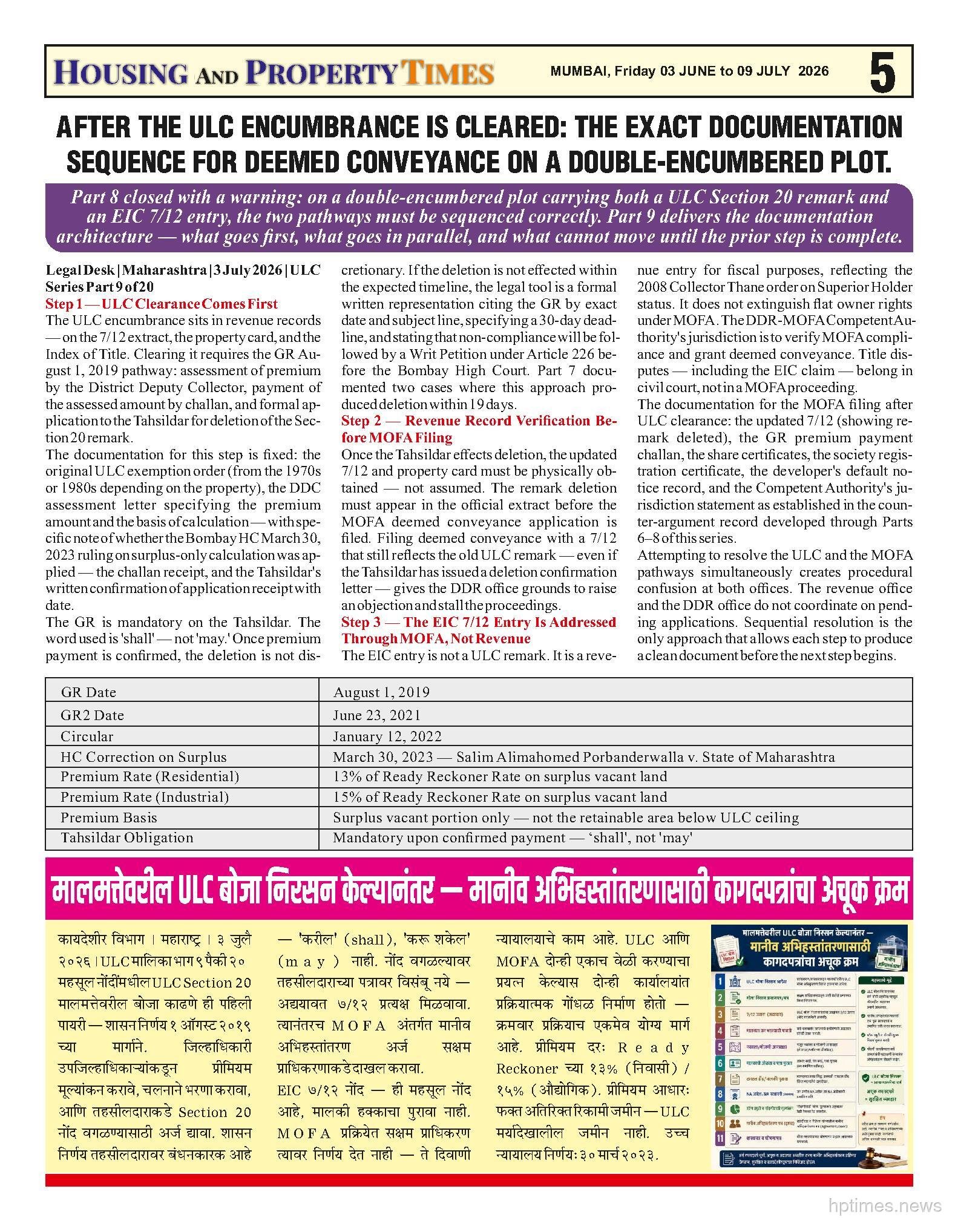
AFTER THE ULC ENCUMBRANCE IS CLEARED: THE EXACT DOCUMENTATION SEQUENCE FOR DEEMED CONVEYANCE ON A DOUBLE-ENCUMBERED PLOT.
Page 4
AFTER THE ULC ENCUMBRANCE IS CLEARED: THE EXACT DOCUMENTATION SEQUENCE FOR DEEMED CONVEYANCE ON A DOUBLE-ENCUMBERED PLOT.
 Page 6
THE DATE IN YOUR AGREEMENT IS THE DATE THAT COUNTS. NOT THE EXTENSION YOUR BUILDER OBTAINED ON THE PORTAL.
Page 6
THE DATE IN YOUR AGREEMENT IS THE DATE THAT COUNTS. NOT THE EXTENSION YOUR BUILDER OBTAINED ON THE PORTAL.
 Page 7
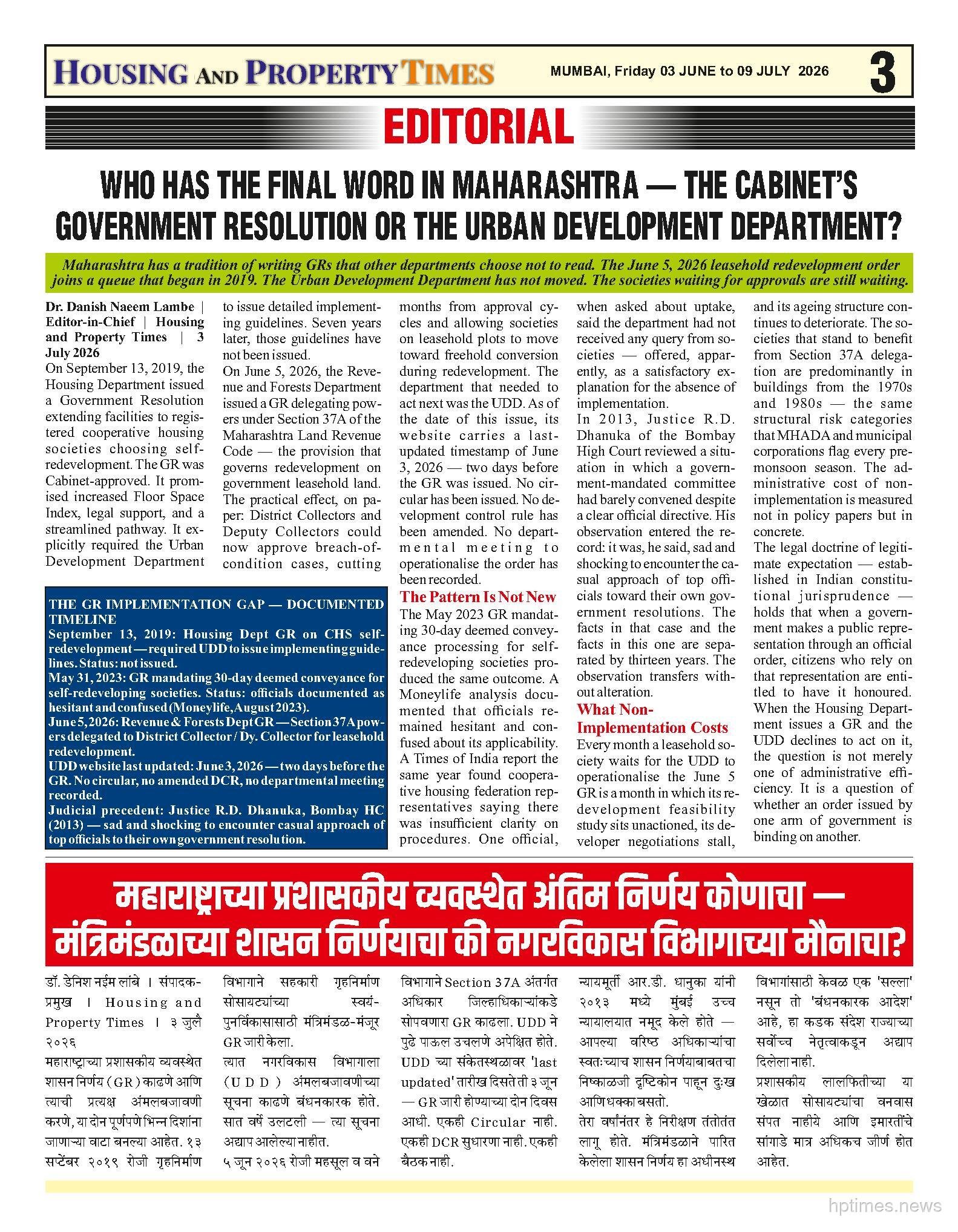
WHO HAS THE FINAL WORD IN MAHARASHTRA — THE CABINET'S GOVERNMENT RESOLUTION OR THE URBAN DEVELOPMENT DEPARTMENT?
Page 7
WHO HAS THE FINAL WORD IN MAHARASHTRA — THE CABINET'S GOVERNMENT RESOLUTION OR THE URBAN DEVELOPMENT DEPARTMENT?
Comments (0)