📖 View in Flipbook All editions
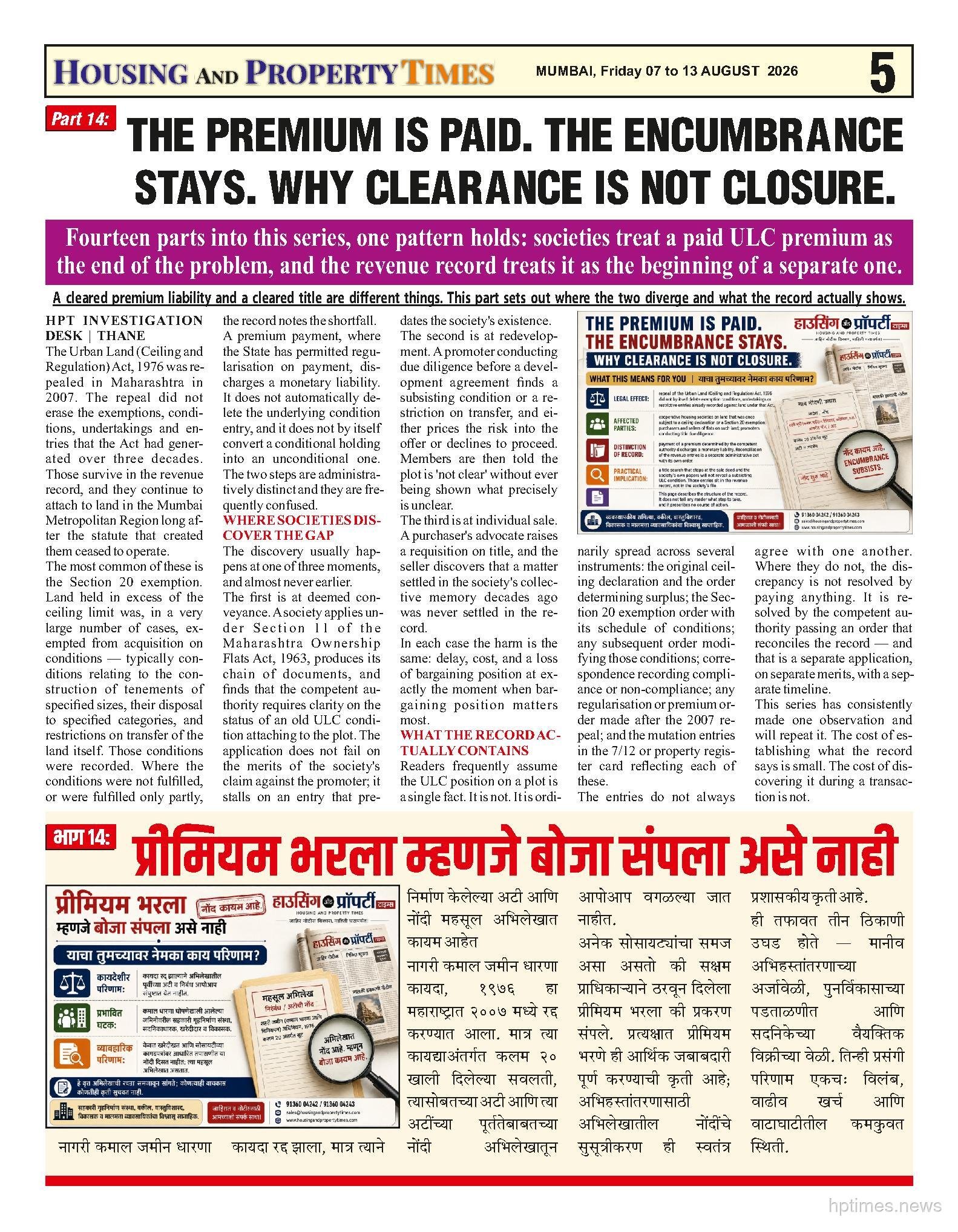
THE PREMIUM IS PAID. THE ENCUMBRANCE STAYS. WHY CLEARANCE IS NOT CLOSURE.
The Urban Land (Ceiling and Regulation) Act, 1976 was repealed in Maharashtra in 2007. The repeal did not erase the exemptions, conditions, undertakings and entries that the Act had generated over three decades. Those survive in the revenue record, and they continue to attach to land in the Mumbai Metropolitan Region long after the statute that created them ceased to operate. The most common of these is the Section 20 exemption. Land held in excess of the ceiling limit was, in a very large number of cases, exempted from acquisition on conditions — typically conditions relating to the construction of tenements of specified sizes, their disposal to specified categories, and restrictions on transfer of the land itself. Those conditions were recorded. Where the conditions were not fulfilled, or were fulfilled only partly, the record notes the shortfall. A premium payment, where the State has permitted regularisation on payment, discharges a monetary liability. It does not automatically delete the underlying condition entry, and it does not by itself convert a conditional holding into an unconditional one. The two steps are administratively distinct and they are frequently confused. The discovery usually happens at one of three moments, and almost never earlier. The first is at deemed conveyance. A society applies under Section 11 of the Maharashtra Ownership Flats Act, 1963, produces its chain of documents, and finds that the competent authority requires clarity on the status of an old ULC condition attaching to the plot. The application does not fail on the merits of the society's claim against the promoter; it stalls on an entry that predates the society's existence. The second is at redevelopment. A promoter conducting due diligence before a development agreement finds a subsisting condition or a restriction on transfer, and either prices the risk into the offer or declines to proceed. Members are then told the plot is 'not clear' without ever being shown what precisely is unclear. The third is at individual sale. A purchaser's advocate raises a requisition on title, and the seller discovers that a matter settled in the society's collective memory decades ago was never settled in the record. In each case the harm is the same: delay, cost, and a loss of bargaining position at exactly the moment when bargaining position matters most. Readers frequently assume the ULC position on a plot is a single fact. It is not. It is ordinarily spread across several instruments: the original ceiling declaration and the order determining surplus; the Section 20 exemption order with its schedule of conditions; any subsequent order modifying those conditions; correspondence recording compliance or non-compliance; any regularisation or premium order made after the 2007 repeal; and the mutation entries in the 7/12 or property register card reflecting each of these. The entries do not always agree with one another. Where they do not, the discrepancy is not resolved by paying anything. It is resolved by the competent authority passing an order that reconciles the record — and that is a separate application, on separate merits, with a separate timeline. This series has consistently made one observation and will repeat it. The cost of establishing what the record says is small. The cost of discovering it during a transaction is not.
React
More from this issue & web
 Page 1
MAHARERA GRANTS ALL PROJECTS FOUR EXTRA MONTHS OVER WEST ASIA WAR
Page 1
MAHARERA GRANTS ALL PROJECTS FOUR EXTRA MONTHS OVER WEST ASIA WAR
 Page 2
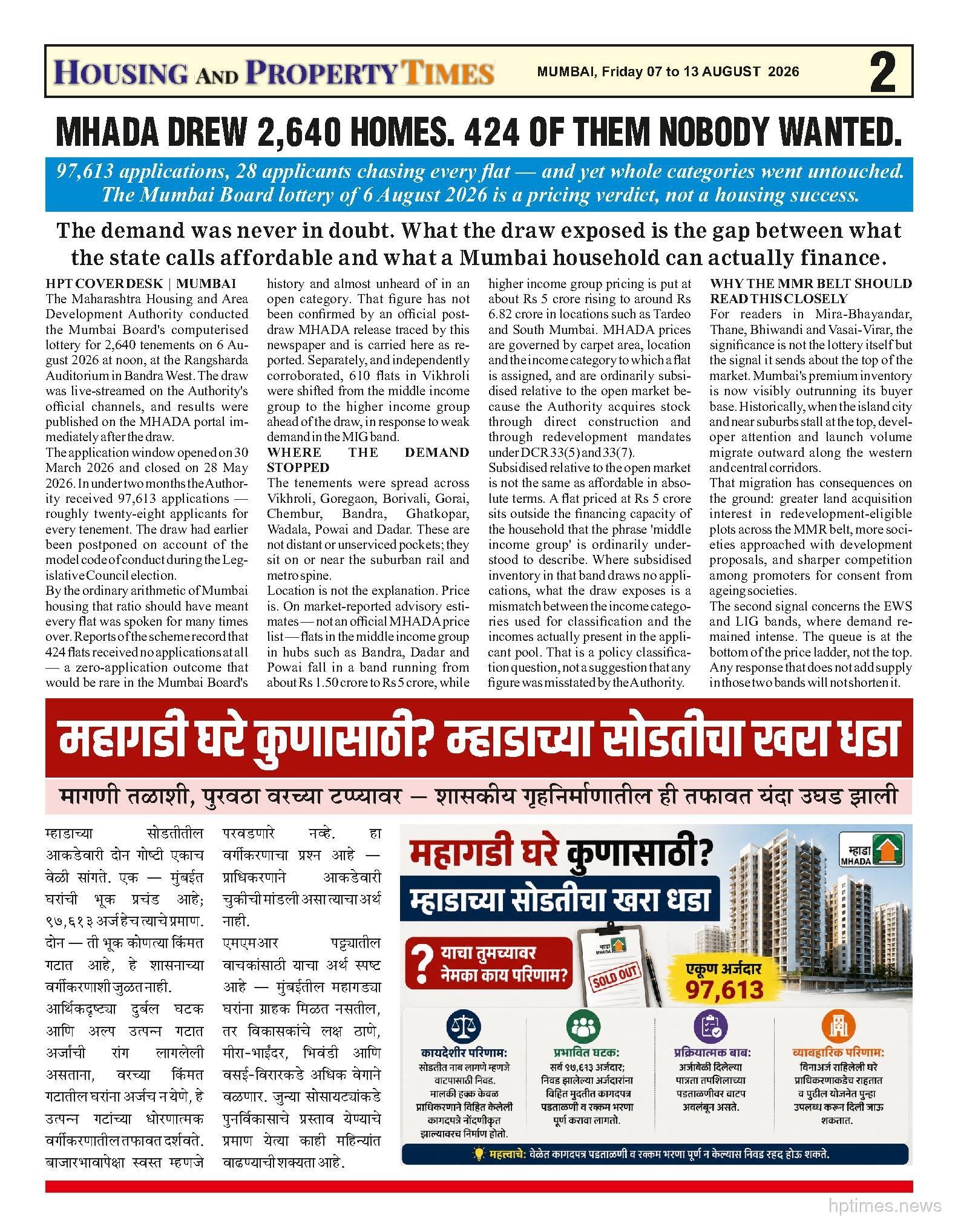
MHADA DREW 2,640 HOMES. 424 OF THEM NOBODY WANTED.
Page 2
MHADA DREW 2,640 HOMES. 424 OF THEM NOBODY WANTED.
 Page 3
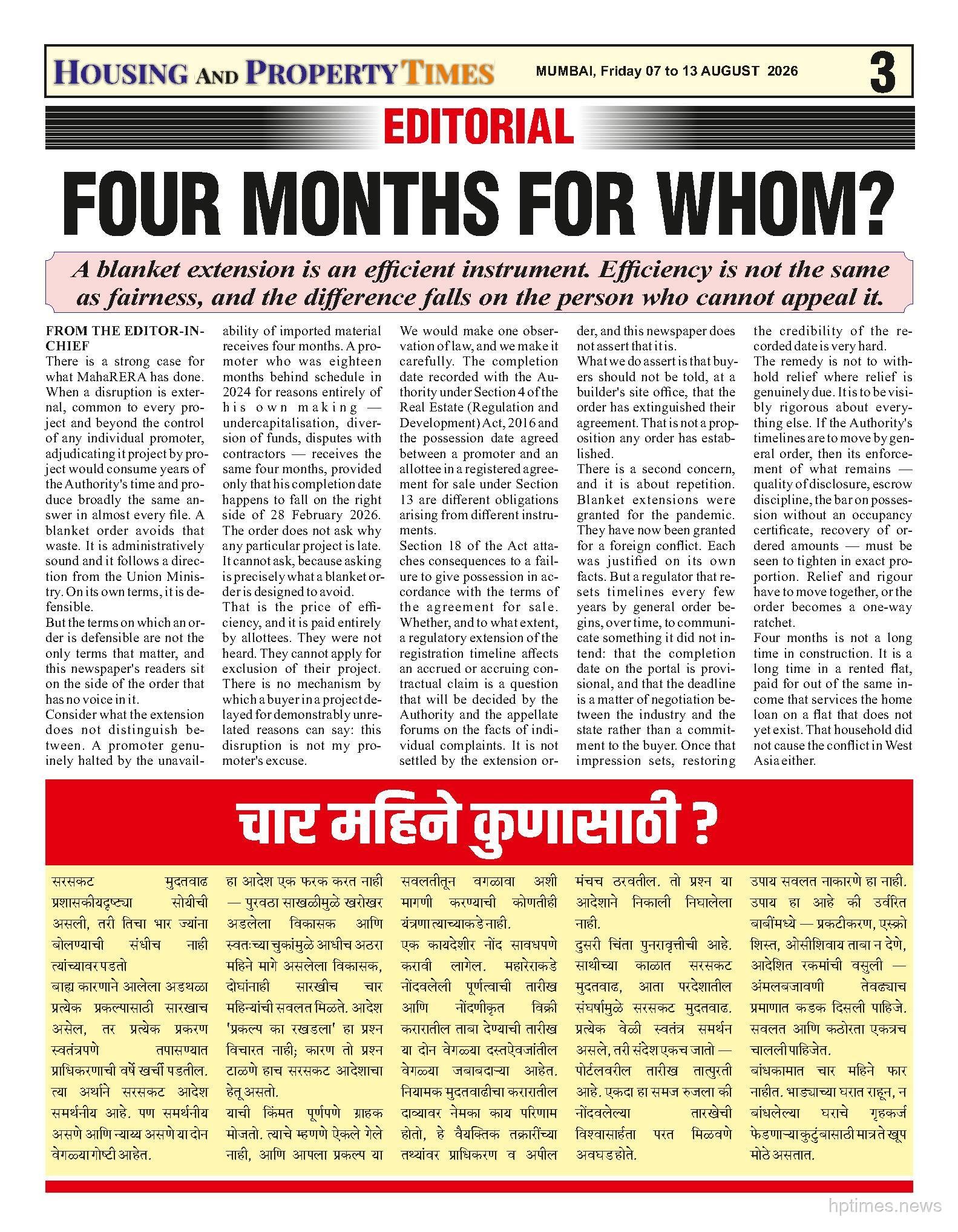
FOUR MONTHS FOR WHOM?
Page 3
FOUR MONTHS FOR WHOM?
 Page 4
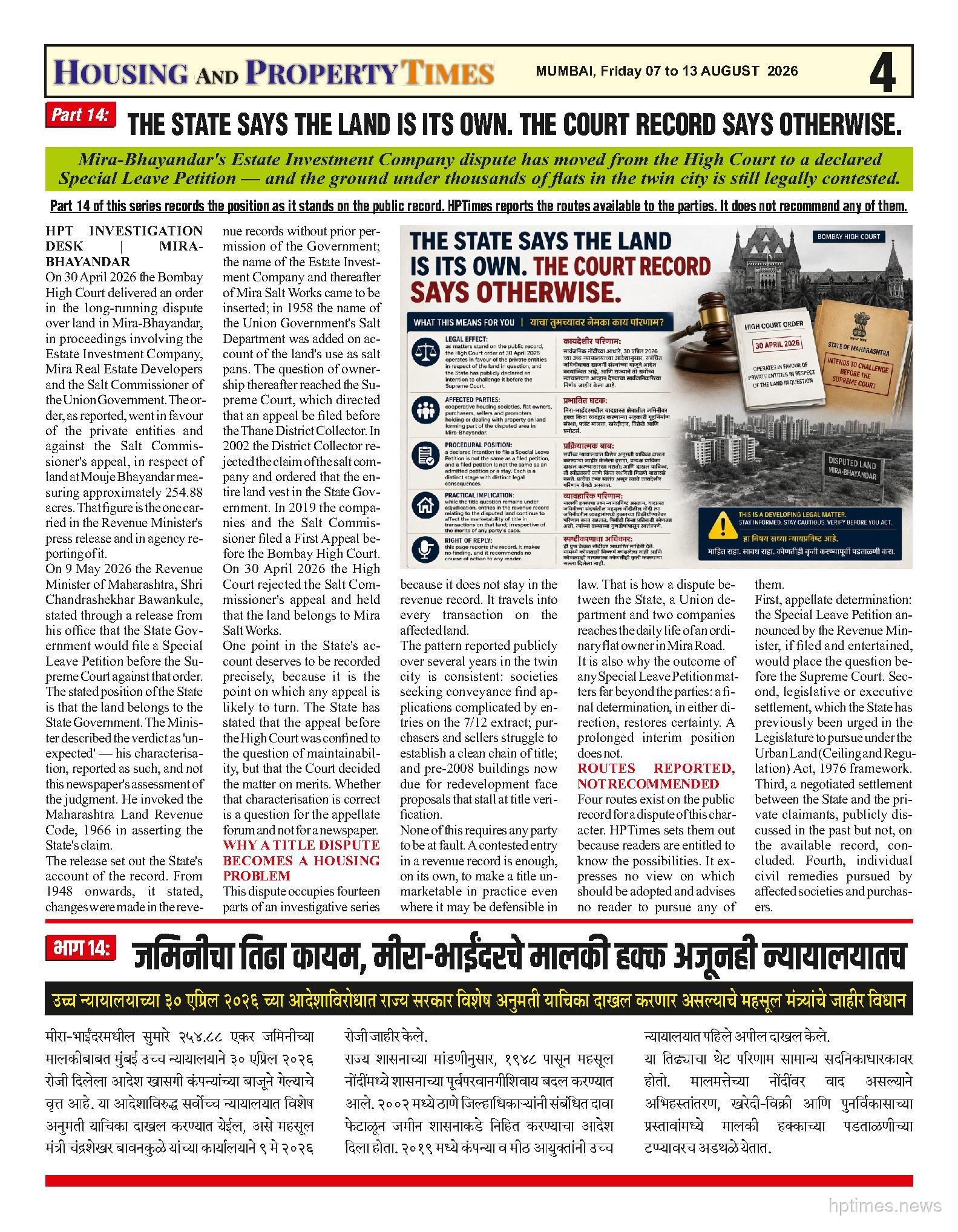
THE STATE SAYS THE LAND IS ITS OWN. THE COURT RECORD SAYS OTHERWISE.
Page 4
THE STATE SAYS THE LAND IS ITS OWN. THE COURT RECORD SAYS OTHERWISE.
 Page 6
"IT REWARDS THE LAWBREAKER." THE MORAL HAZARD OBJECTION, ANSWERED.
Page 6
"IT REWARDS THE LAWBREAKER." THE MORAL HAZARD OBJECTION, ANSWERED.
 Page 7
SUPREME COURT FREEZES ADANI'S 132-ACRE BANDRA AND WORLI CLUSTER MANDATE
Page 7
SUPREME COURT FREEZES ADANI'S 132-ACRE BANDRA AND WORLI CLUSTER MANDATE
Comments (0)