📖 View in Flipbook All editions
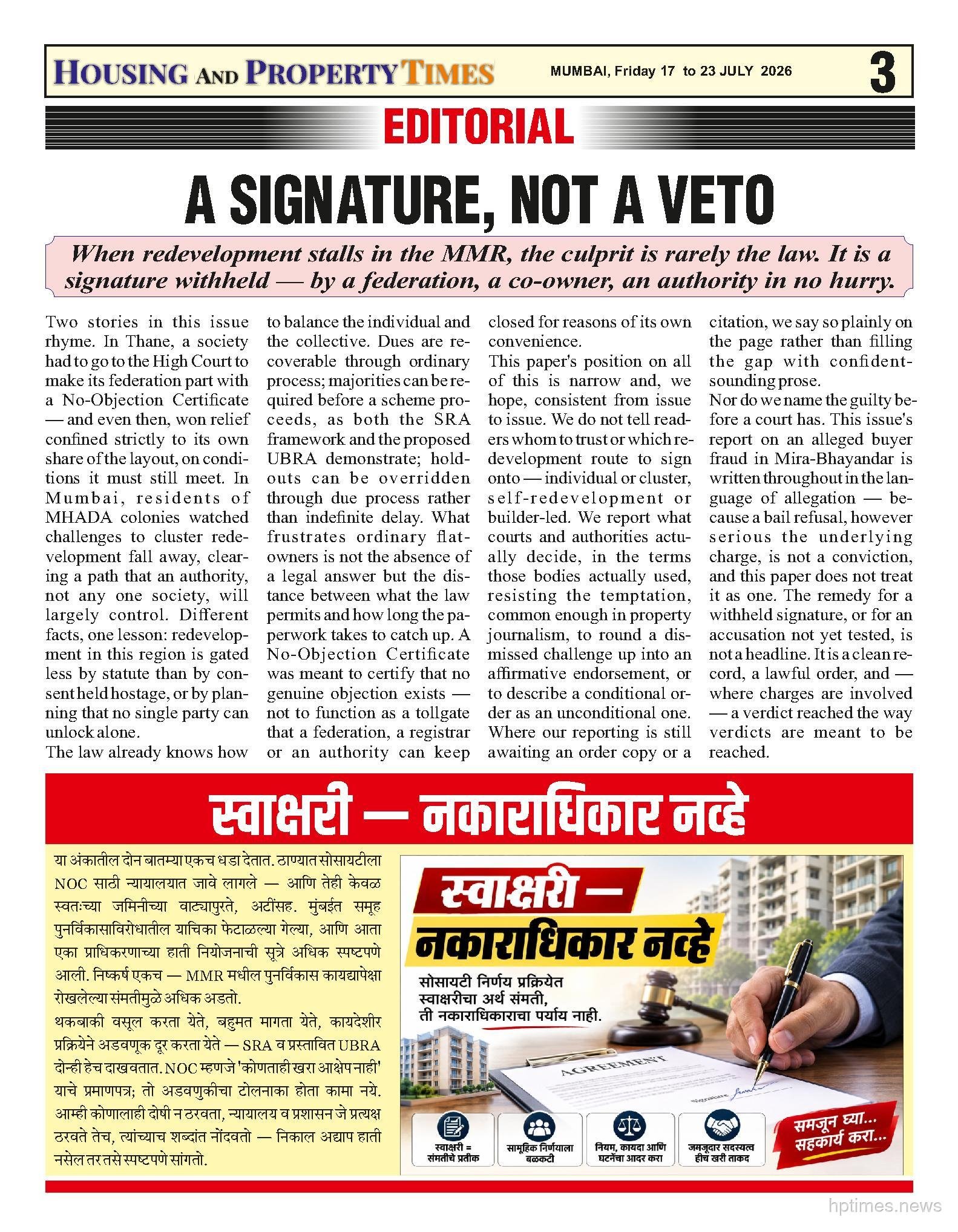
WHY LAND REFORM FREED MAHARASHTRA BUT NOT MIRA-BHAYANDAR
EIC DESK | MIRA-BHAYANDAR The persistence of a colonial land arrangement into 2026 is not unique to Mira-Bhayandar — but its survival is. After 1947, state after state abolished feudal tenures: zamindari, inam, khoti and watan holdings. The Ninth Schedule of the Constitution was created specifically to shield such land-reform laws from challenge under the property-rights provisions. Maharashtra took part fully, through the Bombay Tenancy and Agricultural Lands Act, 1948, the Bombay Merged Territories Miscellaneous Alienations Abolition Act, 1955, and the Bombay Inferior Village Watan Abolition Act, 1958, among others. Where inam abolition applied, superior holders were converted into ordinary rights-holders or extinguished altogether in favour of the cultivating occupant. People who had been paying lagaan to an inam holder — precisely the position residents describe in Mira-Bhayandar today — were freed of that obligation, and the land was recorded directly in their names or their societies'. The Estate Investment Company's claim, however, does not rest on customary tenure. It rests on the Indenture of Grant and Demise of 7 November 1870 — a formal British-era contract for 999 years. As this series has documented, the Bombay High Court's 1958 judgment treated that instrument as a genuine property right. Courts have generally held a 999-year lease to be functionally equivalent to ownership, not extinguishable by administrative fiat without compensation. That is why the inam-abolition model, effective against customary tenures, has not been straightforwardly applied here. The Urban Land (Ceiling and Regulation) Act, 1976 applied to large concentrations of urban land regardless of how ownership arose, and on paper roughly 9,000 acres would fall within its purview — the argument Nana Patole advanced in the legislature in December 2023, tied to the 2008 Collector's order and Section 20. But the ULC Act was repealed in Maharashtra in 2007, which narrows its use as a basis for fresh action even as its bearing on past transactions remains arguable. The nearby Vasai-Virar experience shows the state addressing contested colonial tenures through three tracks pursued together — legislative amendment, administrative correction of 7/12 mutation entries, and judicial proceedings. On the evidence gathered across this series, resolving Mira-Bhayandar would likely require the same combination, culminating — if the courts confirm the lease is valid — in dedicated legislation: a Mira-Bhayandar land-reform statute that acquires the leasehold interest against a legislatively fixed compensation and vests the land in the occupying societies and owners, placed in the Ninth Schedule to withstand an Article 300A challenge. Two things follow for residents living with this claim. First, the abolition of other colonial tenures elsewhere in Maharashtra does not automatically dissolve this one, precisely because the 1870 instrument has been treated in court as a property right rather than a customary grant — the two situations are not legally equivalent, however similar they may look from a resident's kitchen table. Second, a legislation-led route to a full resolution would, on the historical pattern this series has traced, require both a compensation formula and Ninth Schedule protection to survive a constitutional challenge; a state notification alone would not be enough.
React
More from this issue & web
 Page 1
FEDERATION MUST PAY UP, THEN LET GO: COURT POINTS TO TWO-WEEK WINDOW ON REDEVELOPMENT NOC
Page 1
FEDERATION MUST PAY UP, THEN LET GO: COURT POINTS TO TWO-WEEK WINDOW ON REDEVELOPMENT NOC
 Page 2
THE FINE PRINT ON LEASEHOLD: A STAMP-DUTY CUT SOCIETIES SHOULD READ CLOSELY
Page 2
THE FINE PRINT ON LEASEHOLD: A STAMP-DUTY CUT SOCIETIES SHOULD READ CLOSELY
 Page 4
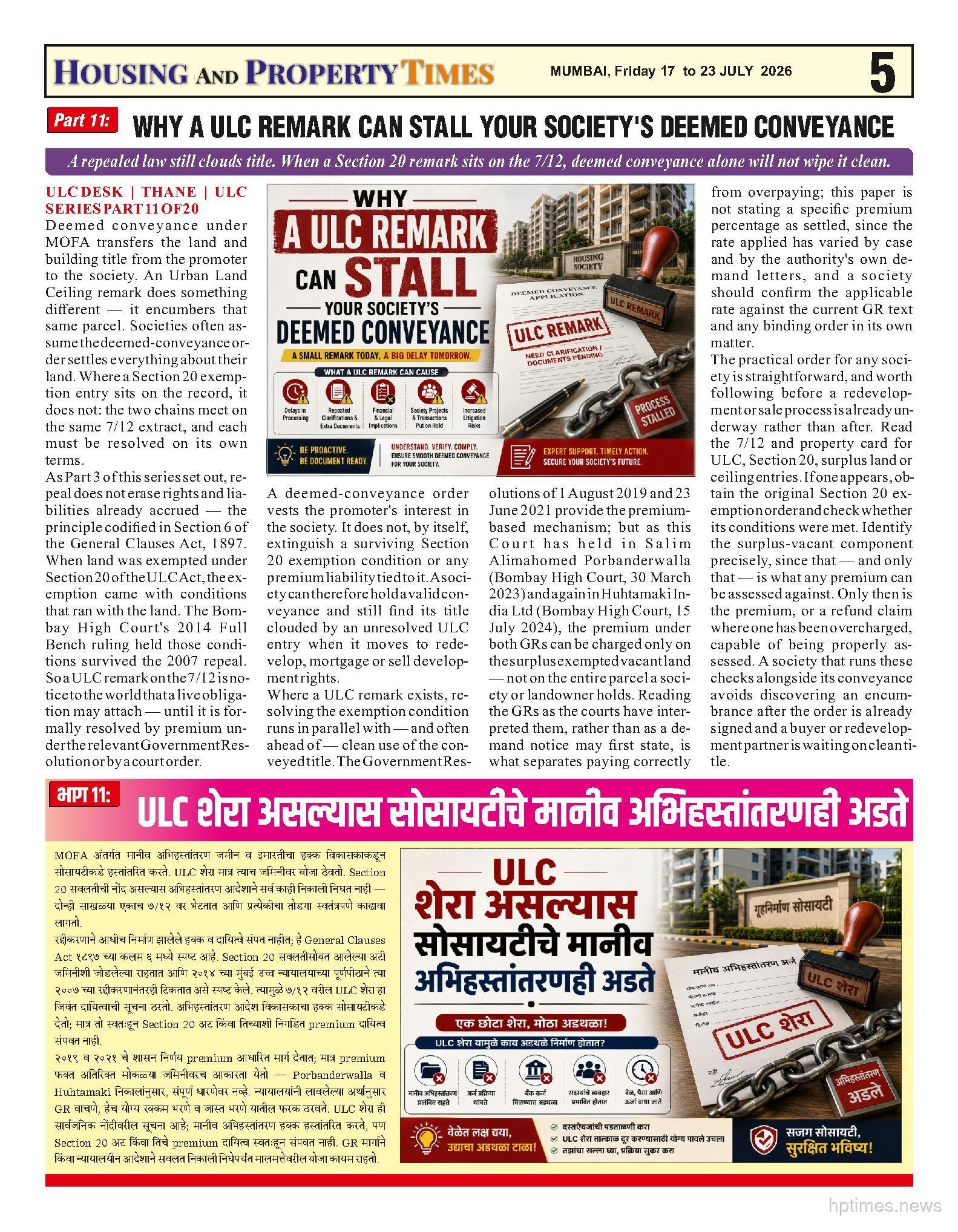
WHY A ULC REMARK CAN STALL YOUR SOCIETY'S DEEMED CONVEYANCE
Page 4
WHY A ULC REMARK CAN STALL YOUR SOCIETY'S DEEMED CONVEYANCE
 Page 5
WHO WOULD RUN UBRA — AND HOW MANY RESIDENTS MUST SAY YES
Page 5
WHO WOULD RUN UBRA — AND HOW MANY RESIDENTS MUST SAY YES
 Page 6
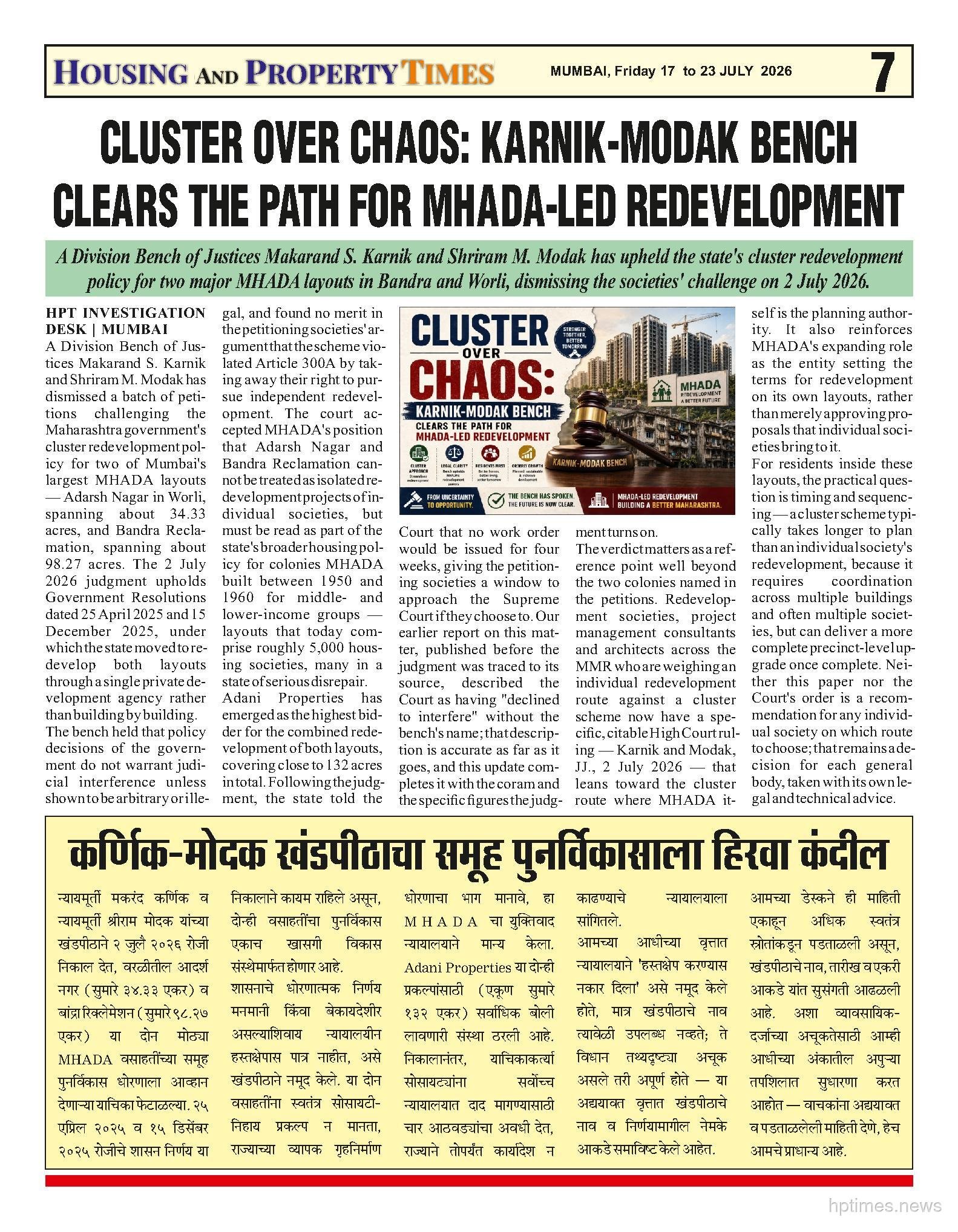
CLUSTER OVER CHAOS: KARNIK-MODAK BENCH CLEARS THE PATH FOR MHADA-LED REDEVELOPMENT
Page 6
CLUSTER OVER CHAOS: KARNIK-MODAK BENCH CLEARS THE PATH FOR MHADA-LED REDEVELOPMENT
 Page 7
A SIGNATURE, NOT A VETO
Page 7
A SIGNATURE, NOT A VETO
Comments (0)