📖 View in Flipbook All editions
WHY A ULC REMARK CAN STALL YOUR SOCIETY'S DEEMED CONVEYANCE
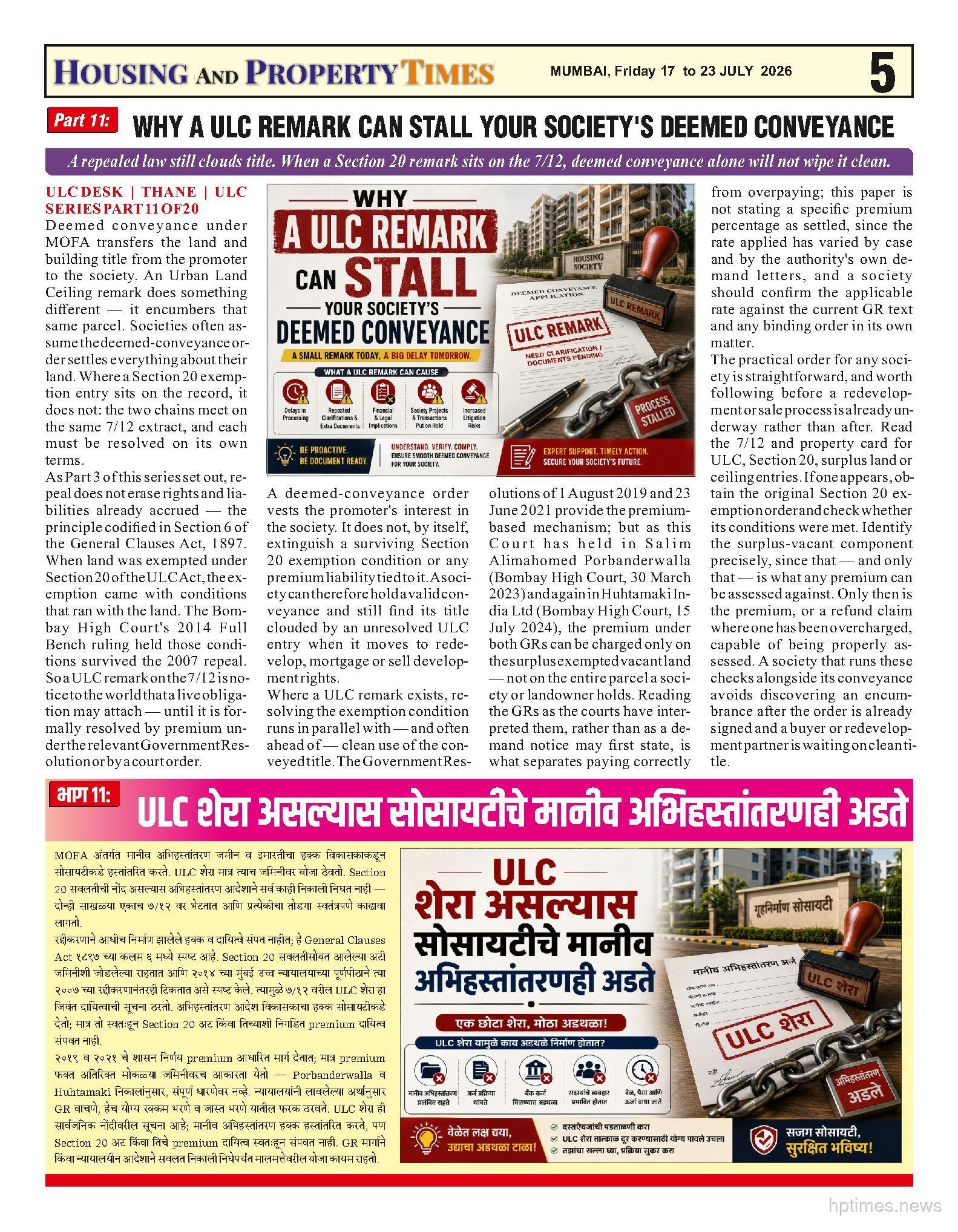
ULC शेरा असल्यास सोसायटीचे मानीव अभिहस्तांतरणही अडते ULC DESK | THANE Deemed conveyance under MOFA transfers the land and building title from the promoter to the society. An Urban Land Ceiling remark does something different — it encumbers that same parcel. Societies often assume the deemed-conveyance order settles everything about their land. Where a Section 20 exemption entry sits on the record, it does not: the two chains meet on the same 7/12 extract, and each must be resolved on its own terms. As Part 3 of this series set out, repeal does not erase rights and liabilities already accrued — the principle codified in Section 6 of the General Clauses Act, 1897. When land was exempted under Section 20 of the ULC Act, the exemption came with conditions that ran with the land. The Bombay High Court's 2014 Full Bench ruling held those conditions survived the 2007 repeal. So a ULC remark on the 7/12 is notice to the world that a live obligation may attach — until it is formally resolved by premium under the relevant Government Resolution or by a court order. A deemed-conveyance order vests the promoter's interest in the society. It does not, by itself, extinguish a surviving Section 20 exemption condition or any premium liability tied to it. A society can therefore hold a valid conveyance and still find its title clouded by an unresolved ULC entry when it moves to redevelop, mortgage or sell development rights. Where a ULC remark exists, resolving the exemption condition runs in parallel with — and often ahead of — clean use of the conveyed title. The Government Resolutions of 1 August 2019 and 23 June 2021 provide the premium-based mechanism; but as this Court has held in Salim Alimahomed Porbanderwalla (Bombay High Court, 30 March 2023) and again in Huhtamaki India Ltd (Bombay High Court, 15 July 2024), the premium under both GRs can be charged only on the surplus exempted vacant land — not on the entire parcel a society or landowner holds. Reading the GRs as the courts have interpreted them, rather than as a demand notice may first state, is what separates paying correctly from overpaying; this paper is not stating a specific premium percentage as settled, since the rate applied has varied by case and by the authority's own demand letters, and a society should confirm the applicable rate against the current GR text and any binding order in its own matter. The practical order for any society is straightforward, and worth following before a redevelopment or sale process is already underway rather than after. Read the 7/12 and property card for ULC, Section 20, surplus land or ceiling entries. If one appears, obtain the original Section 20 exemption order and check whether its conditions were met. Identify the surplus-vacant component precisely, since that — and only that — is what any premium can be assessed against. Only then is the premium, or a refund claim where one has been overcharged, capable of being properly assessed. A society that runs these checks alongside its conveyance avoids discovering an encumbrance after the order is already signed and a buyer or redevelopment partner is waiting on clean title.
React
More from this issue & web
 Page 1
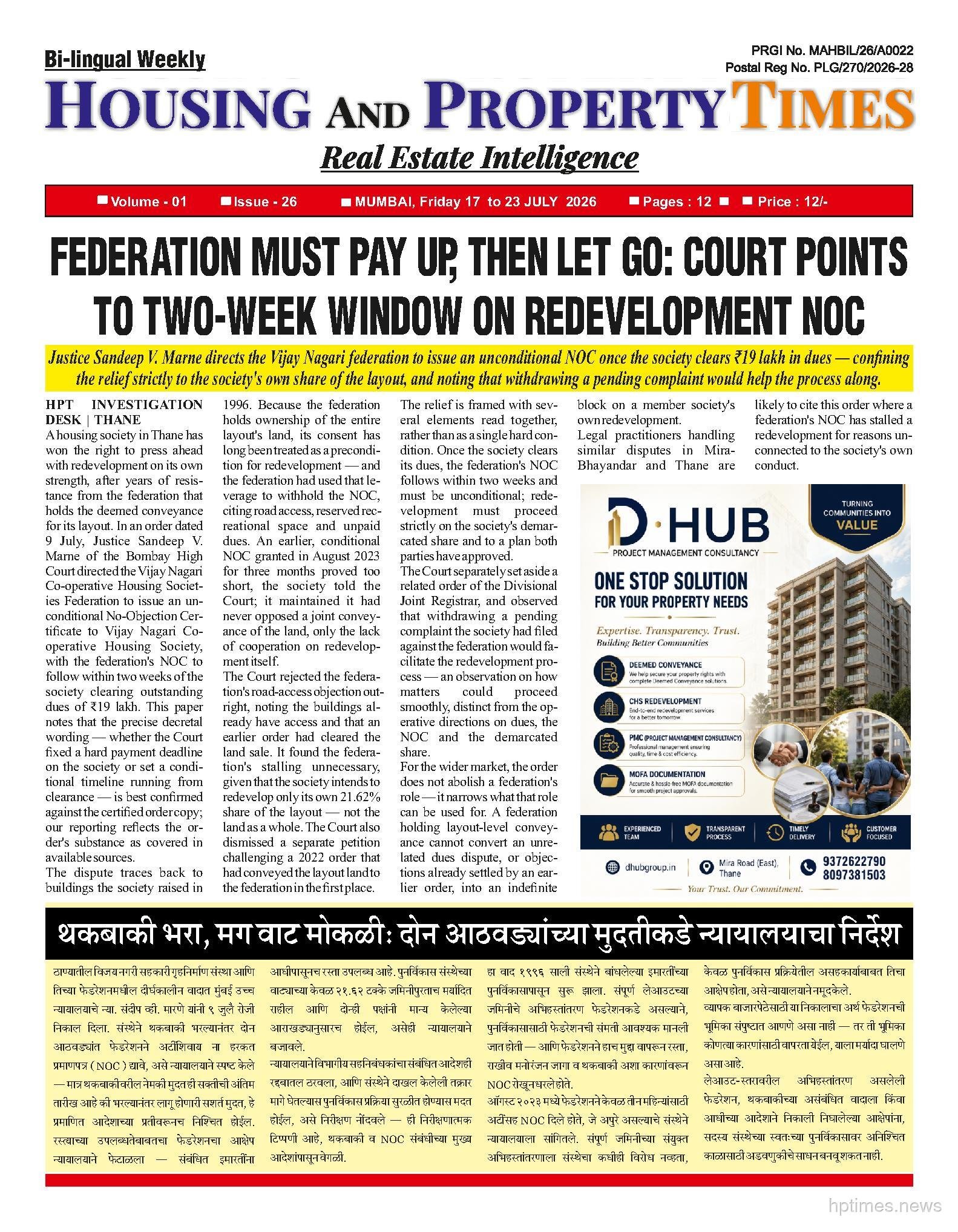
FEDERATION MUST PAY UP, THEN LET GO: COURT POINTS TO TWO-WEEK WINDOW ON REDEVELOPMENT NOC
Page 1
FEDERATION MUST PAY UP, THEN LET GO: COURT POINTS TO TWO-WEEK WINDOW ON REDEVELOPMENT NOC
 Page 2
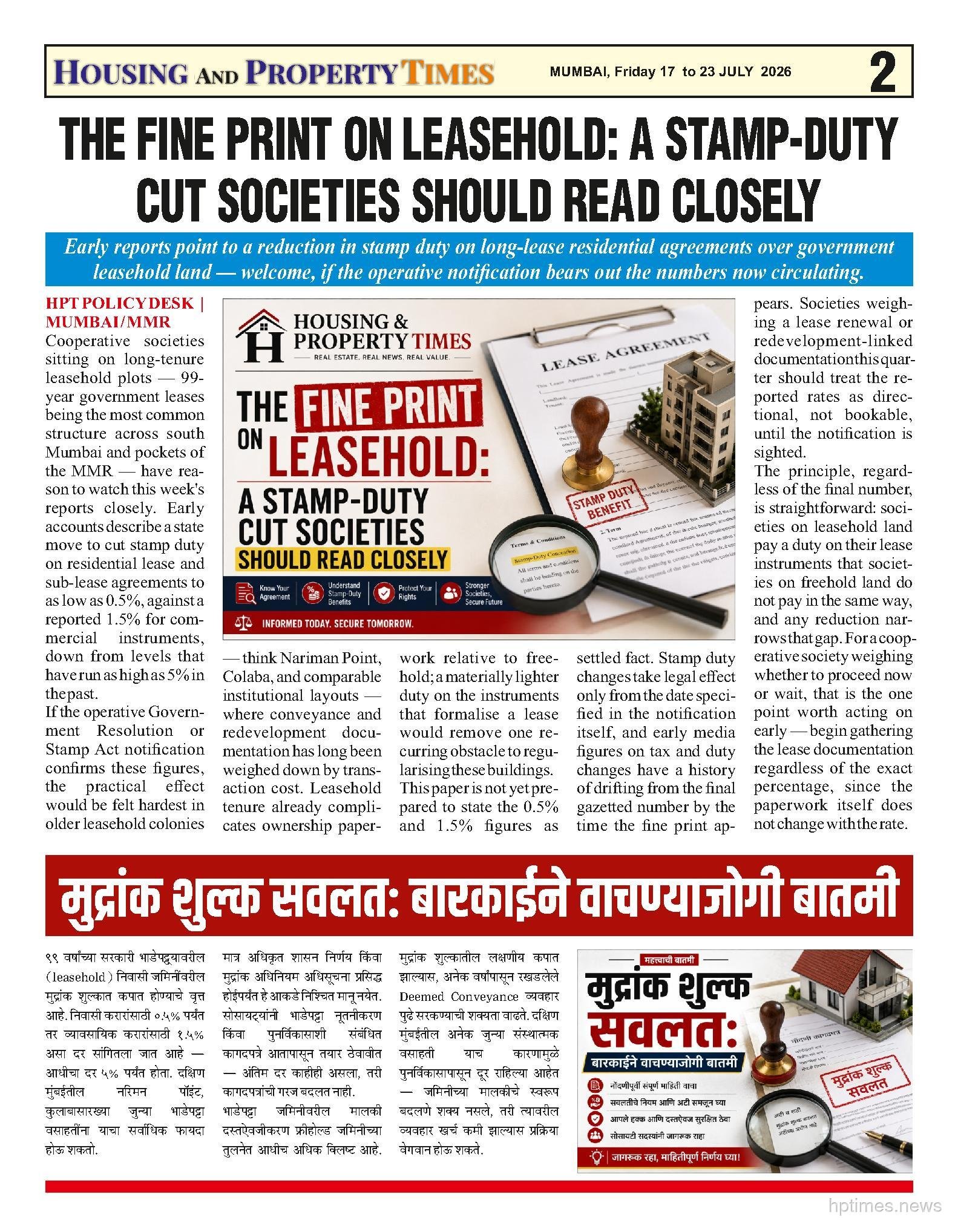
THE FINE PRINT ON LEASEHOLD: A STAMP-DUTY CUT SOCIETIES SHOULD READ CLOSELY
Page 2
THE FINE PRINT ON LEASEHOLD: A STAMP-DUTY CUT SOCIETIES SHOULD READ CLOSELY
 Page 3
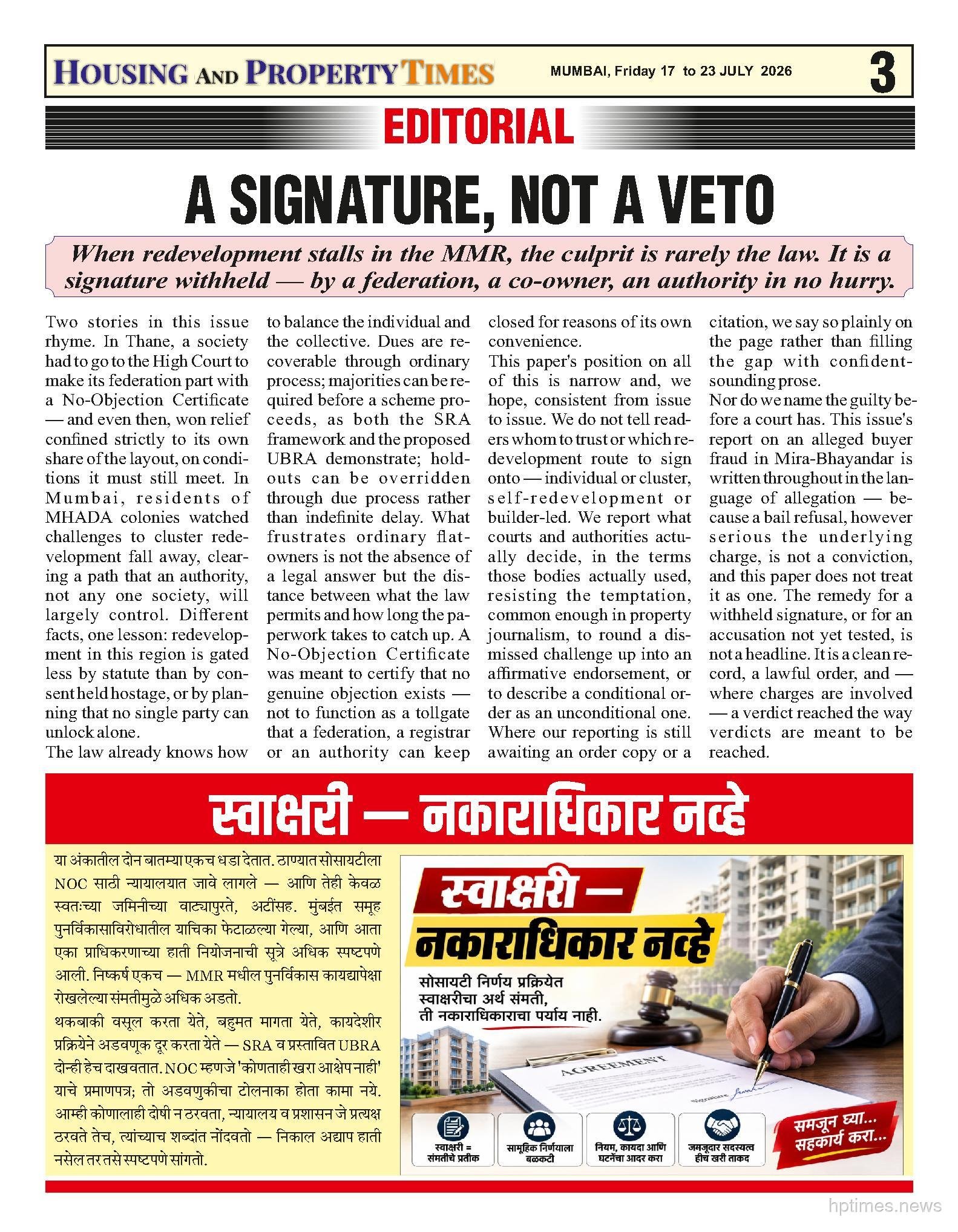
WHY LAND REFORM FREED MAHARASHTRA BUT NOT MIRA-BHAYANDAR
Page 3
WHY LAND REFORM FREED MAHARASHTRA BUT NOT MIRA-BHAYANDAR
 Page 5
WHO WOULD RUN UBRA — AND HOW MANY RESIDENTS MUST SAY YES
Page 5
WHO WOULD RUN UBRA — AND HOW MANY RESIDENTS MUST SAY YES
 Page 6
CLUSTER OVER CHAOS: KARNIK-MODAK BENCH CLEARS THE PATH FOR MHADA-LED REDEVELOPMENT
Page 6
CLUSTER OVER CHAOS: KARNIK-MODAK BENCH CLEARS THE PATH FOR MHADA-LED REDEVELOPMENT
 Page 7
A SIGNATURE, NOT A VETO
Page 7
A SIGNATURE, NOT A VETO
Comments (0)